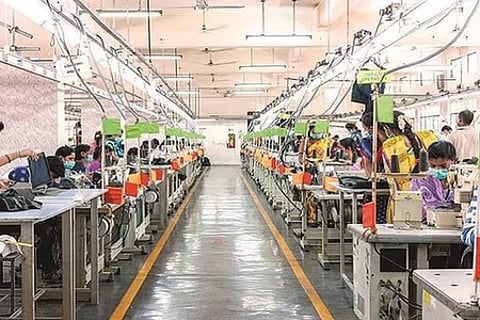

MUMBAI: The 50% US tariffs kicking in from Wednesday will nearly halve the revenue growth of the readymade garments (RMG) industry to 3-5% this fiscal on-year as some of the industry players draw in as much as 40% of their revenue from the US, and cull their profits by 300-500 bps, warns a report.
Crisil Ratings based on an analysis of over 120 RMG makers with total revenue of Rs 45,000 crore said, the only saving grace for the industry to survive is the steady domestic demand.
RMG exports totalled $16 billion last fiscal and accounted for 27% of the sectoral revenue. Of the total a third came in from the US.
The 50% tariff puts India at a distinct disadvantage compared to competing nations like China, Bangladesh and Vietnam, which have much lower duties even in the reciprocal tariff regime that the US has unveiled on its trading partners, the report said Tuesday.
While the US had imposed 25% reciprocal tariffs on Indian goods reaching its shores effective August 7, it has also imposed an additional 25% punitive duties on all goods originating from our shores for buying the partially discounted Russian oil from Wednesday. This takes the duties on Indian goods highest along with that of Brazilian shipments.
According to Manish Gupta, a deputy chief rating officer at Crisil, “if the tariffs hold, RMG exports to the US will see a sharp decline. In the first quarter of this fiscal, total exports rose 10% on-year to $4 billion, with exports to the US recording a 14% growth. The trend is expected to sustain through August 26, till the enhanced tariffs kick in.
“Post 50% tariffs, our exports to the US may be minimal, despite limited capacity of competing nations in value-added garments and lead-time taken by big-box retailers in the US to re-align their sourcing arrangements. Overall, we expect the share of the US in our RMG exports to fall from 33% last fiscal to 20-25% this fiscal,” he added.
This would mean RMP exporters will have to realign trade with other major export destinations—the European Union, England and the UAE, which together form 45% of our exports for fiscal 2025.
The recently signed free trade agreement (FTA) with England is also likely to result in higher exports to that country from the end of this fiscal, providing some relief to the industry.
According to Gautam Shahi, a director with Crisil, the domestic market for RMG, accounting for three-fourths of the sectoral revenue, will continue to see steady revenue growth of 8-10% this fiscal, fuelled by economic growth, interest rate cuts, and the forthcoming GST reductions. This, in turn, will cushion the tariff blow and spur overall growth at the sector level, but at a slower pace than last fiscal.
Weaker revenue growth and tariff-driven competitive disadvantage in the US will impact profitability of the manufacturers, which could contract 300-500 bps as they will bear the tariff brunt. Further, potential oversupply in the domestic market may also impact domestic margins to some extent. Therefore, profitability at the industry level may dip 50-150 bps this fiscal.
This will also pare down exporters credit metrics, with interest coverage dipping to 3.5-3.7 times this fiscal from 3.9 times last fiscal, and financial leverage rising to 3-3.1 times from 2.78 times.
In case the tariffs are returned to the previously announced level of 25%, India could maintain its competitive advantage, given its higher presence in the value-added garments segment compared to its rivals, limiting the impact on exporters.
Overall, the impact on demand in the US because of inflationary pressures and any higher-than-expected increase in cotton prices are all factors that can impact operating performance of the domestic RMG manufacturers.
