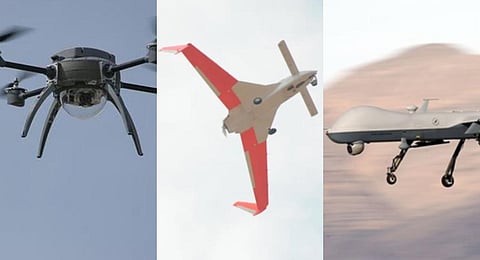

CHENNAI: India has unveiled plans to develop advanced long-range drones and 150-kilogram class loitering munitions powered by fully indigenous Wankel rotary engines, reinforcing its strategic drive toward self-reliance in critical defence technologies. The initiative is designed to curb dependence on foreign suppliers for propulsion systems, a segment that has remained one of the few persistent bottlenecks in India’s unmanned aerial ecosystem despite major progress in domestic airframe, software and weapons development.
The first system to emerge from this effort is a 150-kilogram loitering munition-UAV hybrid platform, tentatively named ‘Loitering Munition-UAV’. Early specifications indicate a standoff strike range of approximately 900 kilometres and an airborne endurance of close to nine hours on a single mission. If validated in trials, the platform would fall into the long-loiter category, offering not just deep-reach precision-strike capability, but also extended surveillance, target tracking and real-time engagement flexibility — without risking pilots or depending on politically sensitive supply chains.
As part of this initiative, the CSIR-National Aerospace Laboratories is set to partner with a private company to develop and manufacture long-range drones, marking a significant shift toward deeper industry participation in strategic UAV programmes. The collaboration signals a move away from largely PSU-led prototypes to a model that combines state-backed R&D strength with private-sector speed, scale and production capability. Defence and industry experts believe the partnership could help accelerate development cycles, expand manufacturing capacity and improve system integration, while also laying the groundwork for India to emerge as a competitive exporter of advanced surveillance and strike-capable drones in the future.
Wankel rotary engines have become a preferred power source in small and medium unmanned systems globally due to their compact size, high power-to-weight ratio, low vibration signature and mechanical simplicity compared to traditional piston-based engines. India’s decision to localise this technology is strategically significant because these engines power several imported loitering systems currently used or assessed by the country. Indigenising the propulsion stack ensures that future Indian unmanned platforms can operate with sovereign supply-chain security, resist geopolitical leverage and integrate more seamlessly with classified mission systems.
The potential applications span both land and maritime domains. With expanding border-security requirements and a widening footprint in the Indian Ocean, long-endurance unmanned platforms offer persistent battlefield presence at a fraction of the cost and human risk of manned aircraft. Loitering munitions fill a distinct tactical gap — combining reconnaissance and strike in a single, rapidly deployable system, and performing missions where timing and real-time decisions determine success.
Beyond strategic gains, the initiative could reshape India’s defence-engine landscape. A scalable domestic Wankel engine programme has the potential to cultivate an entirely new value chain involving apex-seal fabrication, thermal-resistant rotor housings, cooling modules and indigenous engine-control electronics. Success would benefit defence PSUs and startups alike by lowering development costs, shortening iteration cycles and enabling deeper integration with domestically developed strike, navigation and sensor packages. In the long term, it may also unlock export potential for India in the unmanned-propulsion market, particularly among countries looking for non-Western supply alternatives.
The road ahead, however, poses engineering challenges. Wankel engines are highly sensitive to sealing precision, fuel-mix calibration, rotor-housing temperature control and wear-resistant material science for apex seals — components that determine both reliability and fuel efficiency during long loiter phases. The headline range figure of 900 kilometres will also depend on aerodynamic efficiency, flight-profile optimisation and fuel-tank design, making full-scale validation during flight trials essential.
The strategic value of the programme lies not only in the 150-kilogram strike platform itself, but in proving a domestic propulsion system that future drone families could inherit. Once flight-tested and production-qualified, the Wankel engine could expand into maritime-surveillance UAVs, swarm-drone nodes and potentially heavier rotary-powered loitering or cruise-type platforms.
For now, the announcement carries strong signalling impact — India is committing to indigenous propulsion in the long-range unmanned-strike segment. The next milestones that will shape market and military confidence will be prototype flight trials, thermal-performance benchmarks, real-world endurance validation and the decision to transition the programme into scaled production.