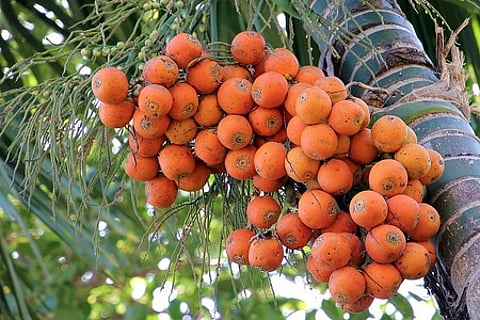

SHIVAMOGGA: India’s dependence on imported arecanut has risen sharply over the past decade, with import volumes and value far outpacing the country’s export growth, according to official data. While arecanut exports showed marginal long-term growth, imports expanded at a much faster rate, widening the trade gap in the commodity and raising concerns for domestic growers.
Areca nut imports remain a major challenge despite the 100% import duty imposed. Data from the Directorate General of Commercial Intelligence and Statistics, given in response to an unstarred question from Lok Sabha Member BY Raghavendra, shows India exported 2,396.26 metric tonnes of arecanut worth Rs 105.84 crore in 2024-25, compared with 6,284.91 MT worth Rs 78 crore in 2015-16. In value terms, exports have grown 35.69% in rupees and just 6.2% in dollar terms over the last 10 years, reflecting modest overall growth with sharp year-to-year fluctuations.
Exports peaked in 2022-23, when shipments touched 13,765.37 MT valued at Rs 485.05 crore, but declined again in the following two years. In 2023-24, exports stood at 10,636.89 MT worth Rs 400.13 crore, before dropping steeply in 2024-25.
In contrast, imports have remained consistently high and have surged in value. India imported 42,236.02 MT of arecanut worth Rs 1,208.34 crore in 2024-25, compared with 45,189.77 MT worth Rs 722.21 crore in 2015-16. The highest imports were recorded in 2022-23, when volumes shot up to 78,233.66 MT valued at Rs 2,182.33 crore, the data shows.
Even after that peak, imports stayed elevated at 40,386.48 MT in 2023-24 and 42,236.02 MT in 2024-25, indicating sustained demand for foreign arecanut in the domestic market. By value, imports in 2024-25 were more than 11 times higher than exports, while in volume terms they were nearly 18 times higher, underlining the widening trade imbalance.
Bangladesh, Sri Lanka, Myanmar and Indonesia emerged as the largest sources of arecanut imports in 2024-25, together accounting for the bulk of inbound shipments. On the export side, Malaysia, the UAE, Sri Lanka and the Maldives were among the top destinations for Indian arecanut during the same year.
The Commerce Ministry said that export promotion activities are being carried out through the Agricultural and Processed Food Products Export Development Authority, including infrastructure support, quality improvement and market development assistance. Arecanut exporters were facilitated to participate in international trade events and buyer-seller meets in 2025.
However, the figures indicate that export growth has not kept pace with the rapid rise in imports, pointing to increasing import dependence despite government-backed promotion measures.
Karnataka Rajya Raita Sangha president K T Gangadhar told The New Indian Express that exports have not grown rapidly as domestic demand is high. “Most of the areca produced in the country is used for panmasala, paints and other industries. Hence, the exports are not picking pace,” he said.
Raghavendra said that he also expressed concern with the minister concerned over import volumes far outpacing the export growth. “I was told that there is huge demand for areca produced within the country,” he said.
It may be noted that India is the world’s largest producer of areca nuts, accounting for about 63% of total global production. In 2023–24, India produced approximately 14 lakh tonnes of areca nuts from 9.49 lakh hectares. Karnataka ranks first, with a production of 10 lakh tonnes from 6.76 lakh hectares, followed by Kerala, Assam, Meghalaya, Mizoram, West Bengal, Tamil Nadu, and others.
