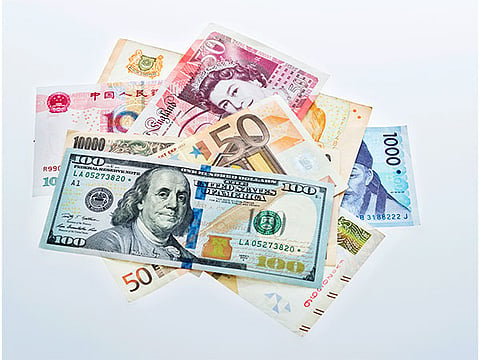

MUMBAI: The rupee continued to bleed for the fifth consecutive day Tuesday--losing more than 1% in just five days—and tumbled 36 paise to breach the sensitive 91-mark for the first time in early Tuesday trade, plumbing to a new low of 91.14. The unit, which has been weighed down by sustained foreign investors’ selloff and a lack of clarity on the trade deal with the US, could barely make any claw-back through the day and closed at 91.075, down 22 paise or 0.24%, taking the year-to-date losses to over 6.2%.
The rupee fell from 90 a dollar to 91 in the just 10 trading sessions. What is more, the value of the rupee has lost almost 50% since this government came to power when the unit was trading at the 60-level.
Today is the fifth consecutive days of steep fall for the rupee which has plunged more than 6.2% year-to-date and is the worst currency globally after the Turkish lira which lost close to 50% against the dollar and the Argentinian peso that has lost more than 45%.
Among the Asian peers, the rupee is the worst, losing over 6.2% while its immediate losing peer the Indonesian rupiah is down only 3.53% and the Philippine peso is down just 1.54%.
The rupee opened week at 90.87 down from the previous close of 90.78 on Monday, which was a loss of 29 paise over its previous close, and continued to loses and plunged 36 paise to hit a low of 91.14 by noon.
VK Vijayakumar, chief investment strategist at Geojit Investment, attributed the rupee weakness to the RBI decision of letting it fall. Moreover the rupee fall was not expected today since the November trade data has come better-than-expected. Covering of short positions must have been the prime driver for today’ record fall, he added.
Anindya Banerjee, head currency and commodities research at Kotak Securities said the pressure on the currency is being driven by three key factors: sentiment, capital flows, and the global macro backdrop.
“On sentiment, uncertainty around the trade deal with the US and the broader trade-war environment is weighing on markets. From a flows perspective, foreign portfolio investors have pulled out close to $2.7 billion in the first two weeks of December alone (and close to $19 billion year-to-date), already among the largest monthly outflows this year, with the month still unfinished.
“Globally, rising US bond yields and expectations of a Bank of Japan rate hike have triggered an unwinding of the yen carry trade. This has led to risk aversion across equities, credit, crypto, and some commodities, adding speculative pressure on emerging-market currencies, including the rupee,” Banerjee said.
Looking ahead Banerjee said in the near term, 90-level remains a key support, while 91.25 is an important resistance. A sustained break higher could open the door towards 92.
"The trade deal still seems to be off by a distance with the commerce secretary saying the first phase will be signed before the end of the year and news that we are closest to the deal being signed. The uncertainty has clouded the recovery on the rupee0dollar pair with dollar buying happening every day," Anil Kumar Bhansali, treasury head at Finrex Treasury Advisors said.
What’s more surprising is that none of the positive numbers are helping the rupee find its feet. Even a massive reduction in trade deficit reported Monday could not bring about a recovery in the rupee with foreign institutional investors outflows continuing, he added.
Foreigners have pulled out close to $19 billion mostly from equities and a smaller portion from debt. They sold equities worth Rs 1,468.3 crore Monday, according to exchange data.
Also, wholesale price inflation stayed in the negative for the second consecutive month in November at -0.32%, even though there was an uptick in prices of food articles like pulses and vegetables on a month-on-month basis, government data showed Monday. Wholesale price index based inflation was at -1.21% in October and 2.16% in November last year.
Again, the continuing weakness of the dollar also is not helping the unit, as the dollar index, which gauges the greenback's strength against a basket of six major currencies, is down 0.03% at 98.27. the index has lost more than 7% so far this year.
Deepak Agrawal, chief investment officer at Kotak Mutual Fund, said the rupee’s record low is primarily driven by external factors, not domestic economic weakness. Key reasons apart from the steep US tariffs include persistent capital outflows, dollar demand linked to non-deliverable forward maturities and if there is a trade deal and if capital flows improved the rupee may appreciate next year.
