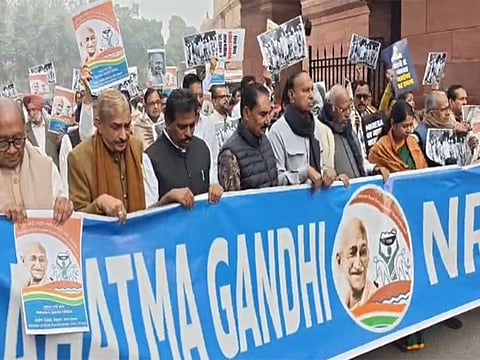

The repeal of the Mahatma Gandhi National Rural Employment Guarantee Act (MGNREGA) and its replacement with another tongue-twister — the Viksit Bharat–Guarantee for Rozgar and Ajeevika Mission (Gramin) (VB-G Ram G) Act — was bulldozed through both Houses of Parliament on Thursday. It left many wondering what was so urgent about replacing a ‘right to work’ scheme that had, despite its problems, built a credible track record.
Amid protests by the Opposition, Union minister Shivraj Singh Chouhan denied that dropping ‘Mahatma Gandhi’ from the Act’s name was a slight to the Father of the Nation, arguing that the name was not part of the original 2005 law. Chouhan also claimed that NREGA was a ‘wasteful’ proposition, doling out huge sums in wages without creating meaningful social assets.
Kicking off a national debate, Leader of the Opposition (LoP) Rahul Gandhi accused the government of demolishing 20 years of work guarantee for the poor in a single day. “It demolishes the rights-based, demand-driven guarantee and turns it into a rationed scheme controlled from Delhi. It is anti-state and anti-village by design,” he said.
NREGA had become an important safety net, especially for the rural poor — the worst hit during droughts or other crises. It would not be unfair to say that the grant of a ‘right to work’ was a major plank on which the Congress won its second-term victory in 2009.
Passed by Parliament in 2005, NREGA guarantees at least 100 days of wage employment in each financial year to every household willing to do unskilled manual labour. The then Manmohan Singh government was possibly inspired by the Maharashtra Employment Guarantee Scheme (MEGS) of 1972, the first to recognise the right to work.
The job guarantee scheme strengthened Panchayati Raj institutions, as they were the vehicles through which the programme was planned and implemented at the village level. Projects were decided in open gram sabha assemblies and ratified by the panchayats.
Work allocation was done directly through the government, without intermediaries, and preference was given to unskilled workers — who had to be employed within a five-kilometre radius of their village.
NREGA’s role as a safety net was most evident during and after the traumatic pandemic years of 2020–2022. The worst affected were the 139 million internal migrant workers who returned to their villages due to lack of work. Support was provided under the government’s Atmanirbhar Bharat stimulus package, which allotted an additional ₹40,000 crore to the programme. This took the total budget to ₹1 lakh crore in FY2021, and wage rates were raised from ₹182 to ₹202 per day.
A study by Azim Premji University found that during the Covid-19 years, returning migrants were compensated for between 20% and 80% of their income loss, thereby shielding the most vulnerable.
The changes in the new Act, starting with its name, hollow out some of NREGA’s most distinctive features. Renaming schemes without core changes has been an old penchant of the BJP government. The Jawaharlal Nehru National Urban Renewal Mission (JNNURM), focused on funding urban infrastructure, was rechristened the Atal Mission.
It is one thing to be reluctant to give credit to a rival political party, and to attempt to extinguish historical recall by erasing the names of Nehru or Indira. But why ‘erase’ Mahatma Gandhi, who has always been a bipartisan symbol of the downtrodden?
More troubling, however, is the dilution of NREGA’s founding principle of ‘work as a right’. Earlier, the scheme was demand-driven, obligating the state to provide work and funds when the unemployed sought employment. Under the new Act, work will be generated through pre-approved plans rather than on demand. This means workers will get work only if a project is available.
Another vital change is the funding pattern. From being an almost entirely Centrally funded scheme, the G Ram G Act shifts to a 60:40 cost-sharing arrangement between the Centre and the states. Poorer states now face a stark choice. If they cannot muster their 40% share, they may be forced to ration work or stop projects altogether.
Job guarantees will also no longer be available year-round. The G Ram G Act mandates a 60-day pause during active sowing and harvesting seasons, assuming farm labour will find sufficient employment — an assumption that is questionable.
To be sure, NREGA’s implementation has been far from flawless. Although the Act guarantees 100 days of employment, the national average has consistently remained below 50 days.
Fund constraints have often forced states to pay wages lower than the notified rate, while delays in wage disbursal are common. Recent data also shows that demand for guaranteed work has not waned. By January 2023, 6.3 crore households had demanded work, but only 5.6 crore received it — leaving 80 lakh households without employment.
If this was the situation when work was a legal guarantee, what will happen now that the guarantee has been withdrawn?
The new Act is clearly designed to sidestep the principle of ‘work as a right’ and, in the long run, reduce the Centre’s financial burden by shifting a portion of it to the states.
