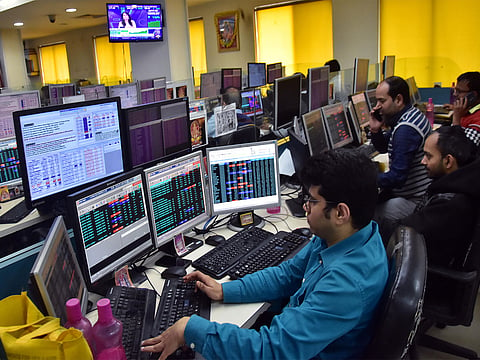

Falling inflation, a boost to consumption from GST rate rationalisation, improving corporate earnings and a steadier pace of economic growth are expected to support markets in the New Year. However, unresolved global issues could continue to inject volatility into domestic assets.
After closing 2025 with its strongest-ever performance, the IPO market is poised for an even bigger year ahead. Meanwhile, the rupee — Asia’s worst-performing currency in 2025— may remain under stress amid foreign fund outflows and uncertainty over a US-India trade deal. Precious metals, which delivered historic gains last year, are expected to scale fresh highs.
Market logs nearly 10% gain in 2025
Indian equities extended their winning streak to a tenth consecutive year in 2025. The benchmark indices—BSE Sensex and NSE Nifty50—rose close to 10% despite global headwinds and record foreign investor selling.
The Sensex surged over 9%, or 7,080 points, during the year to close at 85,220.60, while the Nifty50 advanced 2,485 points, or 10.5%, to end at 26,129.60. The broader market underperformed, with the Nifty MidCap 100 gaining 5.7% and the Nifty SmallCap 100 declining 5.6%.
Investors’ wealth grew by nearly ₹33 lakh crore in 2025 as the total market capitalisation of BSE-listed companies rose from ₹443.47 lakh crore to ₹476.30 lakh crore. Strong domestic participation, resilient fundamentals and lower crude prices supported market momentum. Domestic institutional investors (DIIs) poured over ₹7 lakh crore into equities, cushioning the impact of foreign institutional investor (FII) outflows of ₹1.44 lakh crore in the cash market.
Looking ahead to 2026, analysts believe easing geopolitical risks, moderating tariff tensions and better earnings growth could revive foreign investor interest. However, uncertainty around the US-India trade deal, potential rupee depreciation and risks of a yen carry trade reversal amid rising Japanese bond yields may cap upside.
IPO market set for a bigger show
The primary market ended 2025 on a record-breaking note, raising nearly ₹1.9 lakh crore through about 380 IPOs—well above the 2024 record of ₹1.68 lakh crore. The momentum is expected to accelerate further in 2026, with fundraising estimates pegged at around ₹2.65 lakh crore.
Nearly 100 companies already have Sebi approval for IPOs worth over ₹1.25 lakh crore, while more than 100 firms are in the process of filing draft papers for issues totalling about ₹1.40 lakh crore. Big-ticket names waiting in the wings include Reliance Jio Platforms, Flipkart, NSE and PhonePe.
January alone could see over ₹40,000 crore raised from around 10 companies. Key issues lined up include Zepto (₹11,000 crore), Horizon Industrial Parks (₹2,700 crore), Coal India arm BCCL (₹1,300 crore), CleanMax Energy (₹5,300 crore), Fractal Analytics (₹4,900 crore) and Prestige Hospitality (₹2,700 crore), among others.
Rupee may face stormier near term; downside risks persist
The rupee ended 2025 as the worst-performing currency in Asia and the third-worst globally, losing over 5% after testing the 91-per-dollar level. Analysts expect continued pressure in the near term, with the currency potentially slipping to 92–93 if a US-India trade deal remains elusive and foreign funds continue to exit equities, as they did in 2025 by pulling out a record $18 billion.
Additional downside risks include a widening trade deficit, higher crude oil prices, growth concerns and a weaker rupee stance from the RBI to support tariff-hit exporters. If these risks ease, the currency could recover to the 86–88 range by December 2026.
On December 30, the rupee snapped a three-day losing streak, closing 0.2% higher at 89.79 on index rebalancing inflows and dollar position trimming in thin year-end trade. HDFC Securities expects the rupee to trade in the 89.40–90.26 range in the near term, while DBS Bank sees continued pressure with a potential trading band of 89.5–92.8 by end-2026.
Gold, silver poised for fresh records
Gold and silver delivered their strongest annual rally since 1979 in 2025. Silver surged more than three-fold to touch $83.62 an ounce, while gold climbed to $4,575 an ounce. Analysts expect both metals to scale new highs in 2026.
Gold’s rally—over 81% in 2025—followed gains of 24% in 2024 and 22% in 2023. Wall Street analysts see gold testing the $5,000-an-ounce mark by December 2026, while silver could approach $95–$100 an ounce.
According to the World Gold Council, the rally is being driven by strong central bank purchases, steady ETF inflows, robust retail demand from India and China, and rising industrial consumption. Silver demand has been bolstered by solar panel manufacturing and supply constraints from lower mining output and export curbs by China.
Bond yields likely to remain stable
With the Reserve Bank of India (RBI) having exhausted its most potent weapon—repo rate cuts—in 2025, the coming year is expected to see a stable interest rate regime. Inflation is projected to hover around 4–4.5%, while growth may moderate to 6.3–6.5%, prompting the RBI to stay on hold for most of the year.
Consequently, yields on the benchmark 10-year government bond are likely to remain range-bound, barring any rate surprises. In the near term, G-sec yields are expected to trade between 6.3% and 6.5%, influencing returns on small savings schemes, debt funds and bank fixed deposits.
A Crisil note flagged liquidity conditions, US tariff negotiations, FPI flows, rupee movements, US Fed policy and government borrowing as key yield drivers. Over the medium term, benign inflation and comfortable liquidity could help yields gradually trend lower, said Akhil Mittal, senior fund manager – fixed income, Tata Asset Management.
Small savings rates, linked to G-sec yields, have remained unchanged since July-October 2023 quarter. Though the government left the rates unchanged for January-March 2026 quarter, a revision in the second quarter appears likely. Bank FD rates, currently in the 6.5–7.5% range for one- to five-year tenures, may also edge lower as banks fully transmit recent rate cuts.
Bitcoin price may stabilise amid mixed signals
Cryptocurrencies may see a mixed year ahead as bullish and bearish factors counterbalance each other. In 2025, Bitcoin ended about 5% lower year-on-year, while Ethereum fell over 11%, amid sharp volatility.
According to CoinDCX, Bitcoin is likely to stabilise in the $90,000–$100,000 range heading into January 2026 as markets consolidate gains. Over the longer term, prices could recover towards the $120,000–$150,000 range, supported by rising institutional adoption, steady ETF inflows and tighter supply dynamics following the April 2024 halving.
However, some experts caution that shifts in monetary policy, long-term holder behaviour and the traditional four-year cycle could still signal weakness in the year ahead, even as institutional accumulation continues to underpin Bitcoin’s long-term appeal as a store of value.
Premium properties to drive realty growth
The trend of premiumisation in the housing market will likely continue in 2026 even as overall sales may struggle to log growth. Hit by ever-increasing property prices, layoffs in the IT sector, geopolitical tensions, and other uncertainties, the sector reported a sharp dip in housing sales in 2025. Most industry experts believe that homebuyers in 2026 are likely to increasingly prioritize lifestyle and sustainability driven housing projects. Demand for plotted developments, gated-community villas, premium homes with concierge services, and vacation homes in offbeat locations will remain strong as buyers seek spacious, wellness-focused, and experiential living experiences, according to Colliers.
The consultancy firm added that India’s real estate sector is set to continue its steadfast growth journey marked by institutionalization and diversification, supported by heightened consumption, steady occupier interest and uptick in investor confidence. Demand across both commercial and residential segments is expected to remain healthy, driven by evolving workplace models, rising homeownership, steady improvements in affordability and infrastructure-led connectivity enhancements. In 2026 and beyond, GCCs in India will firmly establish themselves in India. As per Colliers, GCC leasing is expected to reach 30-35 million sq ft in 2026, and account for 40-50% of the Grade A office space demand.
Additionally, India’s urban housing market is set to transform steadily as redevelopment initiatives gather speed across major cities such as Mumbai, Delhi NCR, Bengaluru, Chennai, Kolkata etc. Redevelopment of older and dilapidated buildings will be increasingly supported by favorable Floor Space Index (FSI) policies, Transferable Development Rights (TDR) frameworks, and revised urban planning guidelines, stated Colliers.
