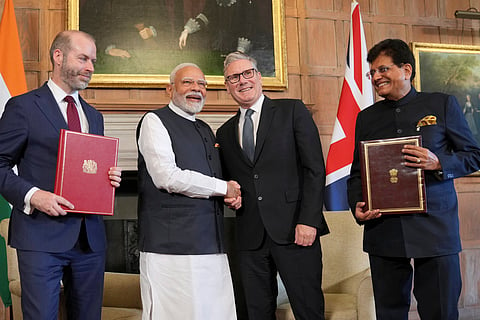

India has secured a commitment from the UK that, if its proposed Carbon Border Adjustment Mechanism (CBAM) -- commonly referred to as a carbon tax -- adversely impacts Indian exports in the future, New Delhi will have the right to seek corrective steps, government sources said.
According to sources, India raised the issue during trade negotiations with the UK. The UK is currently considering implementing CBAM in 2027.
“When we raised the issue during negotiations, the UK acknowledged it. This is important because if their CBAM measures negate the trade benefits we gain, the issue must be addressed. We made that clear,” said a government official who did not wish to be identified.
The UK reportedly told India that since CBAM is not yet in force, it cannot be included in the formal text of the trade agreement. “But there was a clear understanding that, if CBAM affects Indian exports in the future, India will have the right to formally address the issue,” the official said.
Carbon tax is a form of non-tariff barrier. The European Union has already imposed such a tax on imports that result in carbon emissions above a certain threshold. For each tonne of excess carbon emission, a levy ranging from €1 to €100 per tonne is charged.
