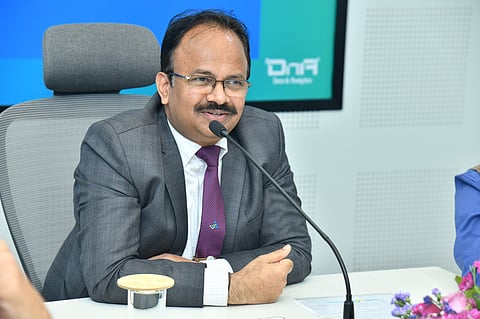

NEW DELHI: Public sector lender Canara Bank witnessed a stellar 22% growth in net profit in the first quarter of the financial year (2025-26). Amid falling Net Interest Income (NII) and Net interest Margin (NIM), the bank remains focussed on growing its loan book. In an interaction with The New Indian Express, the bank's MD and CEO K Satyanarayana Raju says the bank is not in the price war solely for top-line growth. Excerpts
Your interest income is down, and your net interest margin (NIM) seems to have come down sharply. What would you attribute that to? Is it normal in times of falling interest rates to have lower NIMs?
Yes, it's quite normal during a downtrend in interest rates. When the RBI reduces the repo rate, we have to pass on the benefit to borrowers, especially those with repo-linked loans — in our bank, that’s about 45% of our loan book. We do this quickly, usually within a week.
However, we can't reduce deposit rates as swiftly because deposit contracts are locked in. We can only reduce rates for fresh deposits, not for existing ones. So, for six to nine months, each repo rate cut affects our margins.
But when rates go up, banks benefit immediately, as they can increase lending rates right away. The reverse is tougher — NIMs drop for a period of six to nine months after each cut. This has been happening frequently, and the June MPC meeting saw a steep 50-bps cut, so naturally, margins declined.
To cushion the impact, we focus on maintaining or growing our average advances. We ensure more sanctions and disbursements to keep interest income stable. For example, our interest income was ₹31,002 crore in March and ₹31,003 crore in June — we maintained the number. But our NIM fell, and our yield on advances dropped 36 basis points.
You have posted a healthy credit growth of 12.5%, mostly driven by retail lending. Are you happy with this growth?
We are comfortable with our growth. We have been focusing on the RAM (Retail, Agriculture, MSME) sector for the last two years, and it’s showing results. Year-on-year, RAM grew almost 15% in Q1.
In corporate lending, where rate cuts lead to price wars among banks, we prefer to be selective. We are growing at around 10% there. Our strategy is not to join the rate war -- if a corporate wants a lower rate that affects our profitability, we are okay letting go. We had prepayments of ₹11,000-₹12,000 crore in Q1, yet still showed credit growth.
Our cost of funds is higher than peers, so we avoid competing solely for top-line growth. Retail gives us better yields and lower risk, which is why our focus remains on RAM. Corporate growth will be selective, without compromising margins or asset quality.
The 34% retail loan growth -- is that mostly secured lending?
Yes, it is entirely secured. Housing loans are growing at 14%, vehicle loans at 22%. Last year, we introduced a secured personal loan product backed by gold, and that’s growing 30-35%. These are non-agriculture gold loans, used for commercial purposes, with yields 10–15 basis points higher than agriculture gold loans.
Today, gold loans are at ₹56,000 crore, vehicle loans ₹22,000 crore, and education loans ₹18,000 crore. The rest is a mix. We are also industry leaders in the gold loan segment -- our gold loan portfolio stands at ₹1.91 lakh crore. We guided for 16% growth, but may touch 20% -- in Q1 alone, gold loans grew 5%.
Your unsecured loan portfolio is very small?
Yes. Including unsecured education loans, it's around ₹18,000 crore — very small compared to the total.
Coming back to the NIM impact — how long will it take to fully transmit the 100 bps rate cut to deposit rates?
Each rate cut takes 6-9 months to fully reflect in deposit rates. If more cuts happen, the clock resets each time. Since most term deposits are for a year, we can't adjust rates quickly.
You have sharply reduced gross NPAs. How did you manage that?
This is the result of work done over the last two years. It’s now system-driven. We focused on two areas -- first, reducing slippages, and second, improving recoveries.
We created recovery cells in all 177 regional offices with law officers to expedite SARFAESI actions and auctions. For large ticket cases, we set up separate Stressed Asset Management branches and a DRT-focused cell. NPA accounts above ₹20 lakh were shifted to dedicated recovery branches. This verticalization has worked well.
Branches were grouped into buckets based on the number of SME NPA accounts — 100+, 75+, 50+, etc. They were given targets to move into lower buckets. This targeted, branch-level effort has yielded results.
Your MSME NPA ratio is still at 5.34%. Isn’t that high?
Two years ago, it was 14%, so this is a major improvement. In MSME lending, 5% NPAs are acceptable because returns are higher — around 9.7% on average. So, it’s absorbable.
What about microfinance exposure?
We have always been conservative on MFIs. We cap exposure at ₹40 crore per entity, and only the head office sanctions these loans. Total exposure is around ₹200–₹250 crore, so we’re insulated from stress in that segment.
We are also strict on personal loans — we only give them to customers drawing salaries through us. Some banks were aggressive and are now seeing stress. We avoided portfolio buyouts too, which could have led to issues.
And how do you view the new gold loan guidelines?
The new guidelines are very practical and encouraging. Initially, there was confusion about classifying gold-backed loans as agriculture loans. Now, if the borrower voluntarily offers gold as collateral, it can be classified as agriculture.
Also, up to ₹5 lakh can be auto-renewed with only the interest component — no need to repay principal immediately. The LTV ratio has also been raised from 75% to 85%. These steps help expand the gold loan portfolio, which is why we’re confident of exceeding our guidance.
One last question — there has been a lot of talk about imposing fees on UPI transactions. What’s your take?
UPI has become a lifeline, even in rural and semi-urban areas. Many vegetable vendors, fruit sellers, and illiterate users rely on it. Charging them now could push them back to cash.
We need deeper penetration first. Charging a fee prematurely might reverse the gains made in digital payments. As for the cost incurred by banks, I don’t have those figures handy, but I can share them later.
