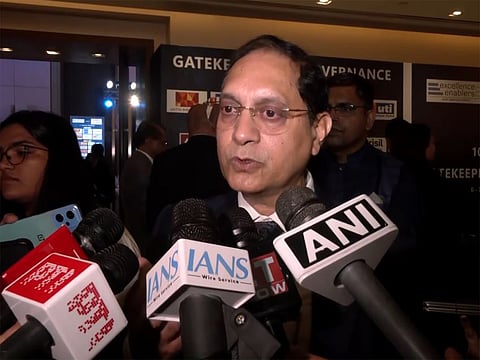

MUMBAI: Amid growing concerns over inflated valuations in some of the recent initial public offerings (IPOs), Securities and Exchange Board (Sebi) chairman Tuhin Kanta Pandey said the regualtor has no role in IPO valuations and that its role is limited to ensuring transparency and full disclosures, not determining valuations.
Emphasising that the pricing of IPOs is determined by market dynamics, he said here Thursday that “Sebi always thinks of transparency. We don't determine valuations, and it remains on the 'eyes of the beholden' and the investor. We cannot intervene in the markets...and decide what would be the price of shares of a company. Share prices will be decided by the markets, depending on the opportunities.” The comments come days after concerns have been raised on Lenskart’s Rs 7,200-crore IPO being priced at a very high level.
The chairman made it clear that Sebi cannot intervene on this aspect, pointing out that the market should freely determine the pricing depending on the opportunities. He further said Sebi’s focus is to ensure that investors have access to accurate and comprehensive information so that markets can independently determine share prices.
“Sebi's main role is to ensure disclosures are robust. We have mandated font size and disclosure of comparatives. We are largely focused on information and disclosures; the rest has to be determined by the capital market itself,” Pandey said. On the role of regulations he said "regulations play a constructive role for market development, but if the regulations become too constraining, too overreaching, and too micromanaging, then they may become problematic," he said.
He added that Sebi wants to maintain a balanced and progressive framework, which can foster trust and growth. He said that the mutual fund industry is an example of the same. Citing the mutual fund industry as an example, Pandey said sound regulation fosters both trust and growth. “Because if the investor protection were not there, the market will also not grow. Take the instance of mutual funds, the mutual fund industry has grown and the investor trust into it also grew because of our regulations,” he said.
On the issue of business responsibility and sustainability reporting (BRSR), Pandey dismissed the notion that the standards are uniform across the board, calling India’s framework “fairly robust” and tailored to local needs. "They are not one size fits all standards. In fact, our BRSR regime is fairly robust and there is also a BRSR core,” Pandey said.
He further elaborated on the scope of implementation, noting that over 1,200 companies are voluntarily adopting BRSR reporting. “So in case of the BRSR, we have mandated 1,000 listed entities and in fact more than 1,200 companies are actually doing it. So that means there are more companies voluntarily to give it. And BRSR core where we have got 46 parameters which will be subject to assurance or assessment system. And there is also a gradual rollout of that. I think ESG roadmap is fairly robust and well thought of and also suitable to Indian needs,” he added.
BRSR is a sustainability reporting framework that allows companies to disclose their non-financial performance on parameters such as environment, social, and governance (ESG) parameters. On a question on public sector undertakings not having the minimum number of independent directors on their boards, Pandey said, “we will only request that the government and the different ministries to appoint the independent directors on time.”