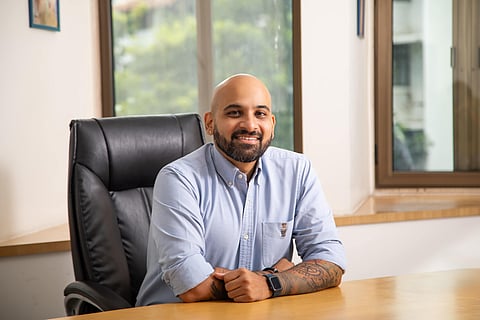

Once a dominant household name in India’s textile landscape, Mafatlal Industries went through one of the harshest business cycles — from the Datta Samant-led mill strike and post-liberalisation shocks to being declared a ‘sick company’ under BIFR. Few expected a revival. Yet today, the 120-year-old legacy business is growing at 30–50% annually, expanding beyond textiles into consumer durables, government businesses, exports, and asset-light manufacturing.
In an interaction with Dipak Mondal, Priyavrata Mafatlal, Vice Chairman, Arvind Mafatlal Group & Managing Director, Mafatlal Industries, recounts the company’s fall, its deep introspection phase, the COVID-era rethink, and the mindset shift that rebuilt the organisation. Excerpts:
Mafatlal was a household name in the 80s–90s. Over time it seemed to fade away. What happened during those 10–15 years, and how did the revival begin?
You’re right — the 80s and 90s were when Mafatlal became a household name. But multiple factors affected us. The 1982 Datta Samant strike shut down 62–63 textile mills in Mumbai almost overnight. That was a massive setback. Then came the liberalisation era of the 90s, when imports opened up and new players arrived. We were playing catch-up.
Around 1999–2000, the company filed for BIFR and was declared “sick”. For eight to nine years, we were in survival mode. Everything was about settling dues, working with creditors, and coming out of BIFR. Eventually we sold land parcels, cleared dues, and emerged — one of the few textile companies to ever come out of BIFR.
From 2011, we began rebuilding. We invested whatever we saved into better machines and began a slow, deliberate process of rediscovering our strengths. By 2016–17 we were still lost. Then we exited denim. It was a 20-year business for us, but Bangladesh and import–export cycles made it unviable. Around this time, the board asked me to take over as Managing Director. Within a year, COVID hit — and surprisingly, that became a turning point.
COVID gave us the time to pause and reflect after 100+ years. We questioned every product, every process, every person. That’s how we rebuilt faster and became more agile. The last 3–4 years of strong numbers are the outcome of this honest, painful, slow journey of rebuilding the foundation.
Tell us about the key decisions and changes made post-COVID that accelerated the turnaround.
A vivid moment for me was December 16, 2018. I had just returned from the US. My father told me: The board wanted me to take over as CEO. They wanted a fresh lens. I had no baggage, so I asked questions about everything. This forced the team to articulate their decisions and rethink their assumptions.
When COVID arrived a year later, the team was already conditioned to ask: “Why can this work?” instead of “Why not?” That mindset shift changed everything. We quickly moved to relevance-based thinking — even making PPE suits at one point, not to create a PPE business but because it mattered then.
Your team mentioned the ‘asset-light’ model. What exactly does that mean for Mafatlal?
When we came out of BIFR, we had multiple businesses — textiles, denim, trading. Over time they merged into Mafatlal Industries Limited.
About 10–13 years ago, MSMEs in the textile sector grew significantly due to strong government support. Earlier, organised mills dismissed the unorganised sector. But today many MSMEs match mill-level quality. Instead of fighting them, we chose to partner with them.
We moved from product-centric to customer-centric thinking. We embraced an FMCG-like mindset: consistent quality, consistent pricing, anywhere in India.
Our strengths are branding, distribution, and execution. Manufacturing remains strategic, not expansive.
How has brand perception changed? For a decade or more, Mafatlal wasn’t very visible.
For many years, even the trade confused us with Arvind Mills of the Lalbhai Group. We kept clarifying. Over time, the textile ecosystem recognised that Mafatlal is strong and independent.
Outside the textile world, people recall the brand fondly — school uniforms, old ads, family references. But they also say the company disappeared from news. That’s why we feel this is the right time to tell our story. We are ready now.
What is your marketing strategy today — especially compared to the iconic TV commercials of the 90s?
We are not trying to recreate the past. And we won’t claim to be number one or number two. Our strengths lie in B2B and B2G — large relationships and execution. B2C exists but mainly online for customer feedback and product learning. We prioritise RoI-based marketing: dealer-level visibility, local advertising, relevant conferences. Not big-bang IPL sponsorships.
Revenue-wise, you now call yourself a consumer durables company with 64% from that segment. Do you plan to rebalance towards textiles?
We will grow both. Consumer durables entered our portfolio because the same customer who buys uniforms or home furnishings also needs digitised classroom tools — especially in education, health and defence, which are our three major focus buckets.
Uniforms will remain a strong part of our business — we clothe 1 in 9 children in India. Branding in uniforms and kids’ categories has grown significantly. Defence is also opening up as ordinance factories reduce dominance.
India’s growth story is strong. Domestic business is stable and now we are adding an export layer carefully, without stretching teams.
