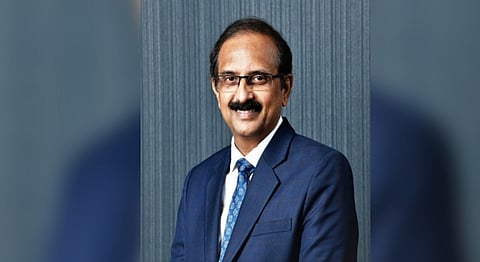

MUMBAI: State Bank chairman Challa Sreenivasulu Setty on Tuesday called for the development of shared digital infrastructure such as a national financial grid and a digital payment intelligence corporation.
This will create a unified digital backbone for financial services which can go a long way to combat frauds and also improve the access to credit, both of which are crucial for achieving the economic vision of being a developed nation by 2047, Setty told a CII event here Tuesday.
He said some work has already been done on the proposed national financial grid. He called for the creation of "a national financial grid that connects all the critical elements in the financial system such as credit bureaus, fraud registries, EKYC facilities, UPI and account aggregator frameworks."
Setty said the under trial ULI (unified lending interface that the RBI is developing) is a step towards achieving the goal of a national grid. "It's one unified open access infrastructure layer that can be leveraged across the ecosystem. As part of that embedding, a shared digital infrastructure for fraud and risk management must also be built," he said.
He said the proposed Indian Digital Payment Intelligence Corporation (IDPIC) will be a shared infrastructure company, similar to what NPCI has done for the payment space.
“We need to create an infrastructure company that enables intelligence sharing on a real-time basis among banks and all other participants in the financial system, so that customer protection from digital frauds can be achieved," he said.
“I think the ULI is one of the most ambitious projects, as ambitious as UPI, if not more, that nobody in the world has ever attempted,” he said, adding, “A shared digital infrastructure for fraud risk management can also be combined with national financial grid. And if we add AI for the anomaly detection networks across entities, we can build a collective shield for the industry."
Setty said while there is progress in financial inclusion with millions brought into the formal banking system (570 million Jan Dhan Accounts opened so far), major gaps remain in credit, insurance, and investments, even as digital adoption surges.
“Millions of deserving small businesses still struggle. We keep telling that we are growing currently in the MSME lending space, which at the system level is growing at 17-18%. But the unmet demand of small enterprises and small businesses is still there forcing them to access informal channels,” Setty said.
At SBI, he said the bank has introduced what is called business rule engine for MSME rating, integrating the data across GST, IT, account statement, and able to give financial approval for an enterprise, wherein a loan is approved within 10-15 minutes. “But the problem is that a lot of them still do not have these data elements available.”
Digital dataprints secure real-time digital financial identity capturing the key financial datapoints such as GST returns, tax filings, banking history, utility payments, and invoice flows. This digital consolidated footprint will enable any bank, NBFC, or insurer to access validated data and instantly assess eligibility for loans, insurance, or even loans, he said.
“Banks need to focus on the four I's--infrastructure, inclusivity, innovation, and intelligence—to accomplish sustainable growth over the long-term,” Setty concluded.
Meanwhile, addressing the same event, financial services secretary M Nagaraju said the financial sector is evolving with greater maturity and expanding its reach to fulfill the aspirations of all sections of society, including marginalised communities and small businesses. With increased openness, innovation, and technology adoption, the financial sector also is positioning itself to drive the economic vision for 2047 when India completes a century as a free nation, he added.
He also said the financial sector is stronger than ever, through financial inclusion with Jan Dhan accounts surging to 57 crore, of which 55.7% are held by women and digital transformation with UPI now accounting for nearly 80% of digital payments indicating affordability and wider reach. At the same time, NPAs are at historic lows, and key stress indicators in the banking ecosystem continue to decline quarter after quarter, reflecting a system that is responding effectively to ongoing reforms.