
The RBI-led Monetary Policy Committee has unanimously kept the repo rate at 5.5% and maintained the neutral stance, adopting a wait-and-watch approach amidst US tariff woes and geopolitical developments. This decision follows 100 bps cuts delivered earlier.
The decision is in line with analysts' expectations and follows the August policy review, when it had taken a wait-and-watch approach to assess the impact of US tariffs and other global developments on the domestic economy.
The rate-setting panel also reduced its FY26 consumer price inflation projection from 3.7% to 3.1%. However, it said it expected inflation to inch up above 4% by Q4 and beyond.
The committee also retained its growth forecast for the year, even as it keeps a wary eye on the global tariff turmoil.
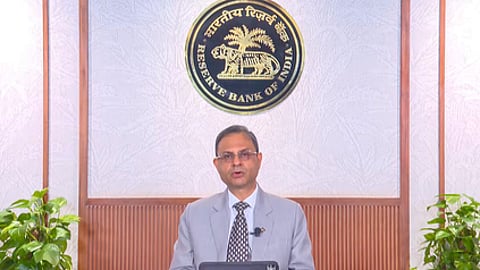
The six-member panel voted unanimously to keep the repo rate at 5.5%, maintaining its neutral policy stance, Governor Sanjay Malhotra said Wednesday.
Repo rate is the rate at which the central bank lends money to commercial banks for short-term needs. One basis point equals 0.01%.
"The current macroeconomic conditions, outlook and uncertainties call for continuation of the policy repo rate of 5.5%," Malhotra said, adding the committee would "wait for further transmission of the front-loaded rate cuts to the credit markets and the broader economy."
The MPC observed that the overall inflation outlook has turned even more benign in the last few months, due to the reasons discussed above. The average headline inflation for 2025-26 is now revised lower from 3.7 per cent and 3.1 per cent projected in June and August policy, respectively, to 2.6 per cent, the governor said.
Growth outlook remains resilient, supported by domestic drivers, despite weak external demand. It is likely to get further support from a favourable monsoon, lower inflation, monetary easing and the salubrious impact of recent GST reforms. However, growth continues to be below our aspirations.
Even though the growth projection for the financial year 2025-26 is being revised upwards, the forward-looking projections for Q3 and beyond are expected to be slightly lower than projected earlier, primarily due to tariff-related developments, despite being partially offset by the impetus provided by the rationalisation of GST rates.
To summarise, Malhotra said there has been a significant moderation in inflation. Moreover, the prevailing global uncertainties and tariff-related developments are likely to decelerate growth in H2 and beyond.
The current macroeconomic conditions and the outlook have opened up policy space for further supporting growth. However, the MPC noted that the impact of the front-loaded monetary policy actions and the recent fiscal measures is still playing out.
The trade-related uncertainties are also unfolding. The MPC, therefore, considered it prudent to wait for the impact of policy actions to play out and greater clarity to emerge before charting the next course of action.
In terms of the inflation outlook for H2, healthy progress of the south-west monsoon, higher kharif sowing, adequate reservoir levels and a comfortable buffer stock of foodgrains should keep food prices benign. The recently implemented GST rate rationalisation would lead to a reduction in prices of several items in the CPI basket.
Overall, the inflation outcome is likely to be softer than what was projected in the August MPC resolution, primarily on account of the GST rate cuts and benign food prices. Despite the anticipation of moderate momentum during H2, large unfavourable base effects are likely to exert upward pressure on headline CPI inflation, especially in Q4.
Considering all these factors, CPI inflation for 2025-26 is now projected at 2.6 per cent, with Q2 at 1.8 per cent; Q3 at 1.8 per cent; and Q4 at 4.0 per cent. CPI inflation for Q1:2026-27 is projected at 4.5 per cent, with risks evenly balanced, Malhotra concluded.
