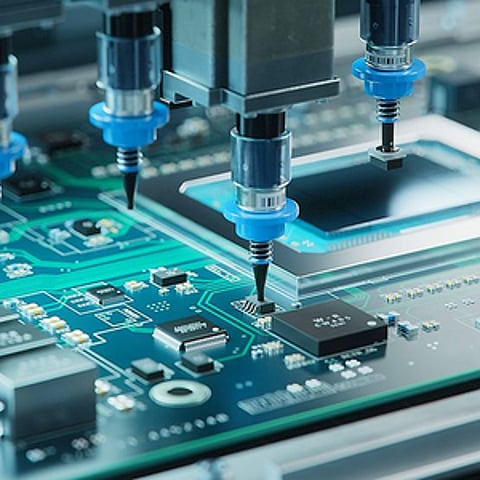

The government on Monday approved seven projects worth Rs 5,532 crore under the Electronics Components Manufacturing Scheme (ECMS). According to the Ministry of Electronics and Information Technology (MEITY), these projects will lead to production of components worth Rs 36,559 crore and creation of over 5,100 direct jobs. The approved units are spread across Tamil Nadu (5), Andhra Pradesh (1), and Madhya Pradesh (1), and will manufacture multi-layer printed circuit boards (PCBs), HDI PCBs, camera modules, copper clad laminates, and polypropylene films.
Four of these projects have gone to Bengaluru-based Kaynes Technology, and one each to SRF Ltd, Syrma Strategic Electronics, and Ascent Circuits Pvt Ltd.
According to a Meity statement, the scheme has received wonderful response from both domestic and global companies. “249 applications have been received representing Rs 1.15 lakh crore investment, Rs 10.34 lakh crore production, and 1.42 lakh jobs to be created. It is the highest-ever investment commitment in India’s electronics sector,” the ministry said in a statement.
While making the announcement, Union Minister Ashwini Vaishnaw said that 20% of the domestic demand of PCBs and 15% of camera module sub-assembly will be met through production from these plants. He also mentioned that the demand of copper clad Laminate will now completely be domestically met. The additional 60% of production through these plants will be exported.
The ECMS was officially notified on April 8, 2025 with an outlay of Rs 22,919 crore. The scheme will be implemented over a period of six years.
Under ECMS, both turnover-, and capex-linked incentives would be given to the approved projects. Companies must meet both incremental sales and investment targets annually to qualify. Failure to meet employment generation targets will lead to a 1% deduction from the eligible incentives. Capex-linked incentives are based on eligible capital expenditure incurred within five years, with a 5% deduction applied if employment generation requirements are not fulfilled.
Applicants must meet minimum revenue thresholds in either Electronic System Design and Manufacturing (ESDM) or pure manufacturing for their selected segments. For those applying under the supply chain and capital equipment categories, companies must demonstrate a net worth equal to at least 50 percent of the proposed investment, or alternatively submit a board resolution affirming their investment commitment and source of funding.
Eligible expenditures include costs related to plant, machinery, tools, dies, research and development, technology purchases, and captive utilities. Expenses on freight, transport, insurance, and commissioning are capped at 7.5% of the base machinery cost, while technology acquisition costs are capped at 10%.
