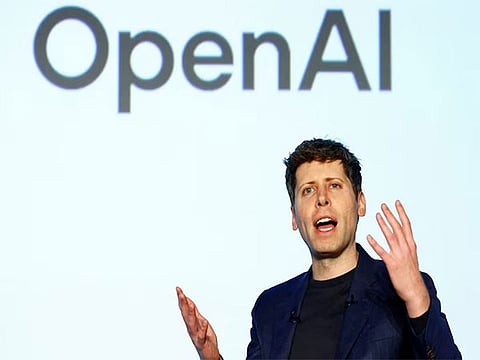

CHENNAI: OpenAI chief executive Sam Altman has unveiled on Thursday an audacious trillion-dollar plan to massively expand the company’s artificial intelligence infrastructure, signalling a decisive shift from a research-focused organisation to a large-scale commercial powerhouse.
A Reuters report said; Altman announced that OpenAI aims to build about 30 gigawatts of computing capacity at an estimated cost of $1.4 trillion, with an ambitious long-term goal of adding 1 gigawatt every week. The plan, he said, reflects the enormous computing demand expected from the next generation of AI systems.
The announcement follows a major restructuring deal with Microsoft that lifted previous fundraising limits for OpenAI, giving it access to unprecedented levels of capital. Altman said the company will need to generate “hundreds of billions” of dollars in annual revenue to sustain and justify this scale of investment.
The project’s scale places OpenAI far beyond the traditional boundaries of software companies. Building 30 GW of computing power will require vast energy resources, data-centre infrastructure, and semiconductor supply, drawing comparisons to national-level infrastructure programmes. Analysts say the move positions OpenAI as a future “AI infrastructure utility” — a foundational layer of the emerging artificial intelligence economy.
Altman’s vision has drawn both admiration and caution. Supporters view it as a necessary step to advance artificial general intelligence (AGI) and to keep pace with rapidly growing demand for AI services. Critics, however, warn that such massive spending could create financial and environmental strains, especially if the company struggles to monetise its technology at the projected scale.
Each gigawatt of compute capacity currently costs over $40 billion, though Altman expects costs to fall as technology improves and supply chains expand. Even so, achieving weekly capacity additions will be an unprecedented logistical and financial challenge.
The expansion is also expected to have wide economic ripple effects. It could reshape global semiconductor demand, boost data-centre construction, and influence energy markets. Governments are likely to scrutinise the project’s environmental impact, given the immense power consumption and carbon footprint associated with large-scale AI operations.
Industry observers note that OpenAI’s trillion-dollar strategy marks the next phase of competition among AI leaders such as Google DeepMind, Anthropic, and Amazon. As computing becomes the new frontier of AI dominance, access to power, chips, and capital will define who leads the next wave of technological innovation.
While Altman’s plan carries significant execution risks — including cost inflation, regulatory hurdles, and potential oversupply — it also underscores a fundamental truth: artificial intelligence has entered a new era where scale, infrastructure, and energy have become as critical as algorithms themselves.
