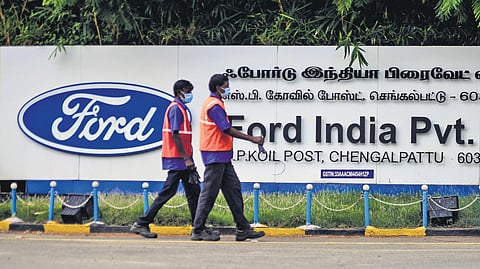

CHENNAI: Ford Motor Company plans to invest Rs 3,250 crore (about $370 million) in India, marking a renewed commitment to the country’s manufacturing sector despite pressure from the Trump administration to focus production within the US.
The investment will be directed toward reviving and retooling Ford’s Maraimalai Nagar plant near Chennai in Tamil Nadu. The facility, which had been largely idle since the company’s exit from vehicle manufacturing in 2021, will now be upgraded to produce next-generation engines for export markets. According to reports, the engines will not be shipped to the US but to other global destinations.
The plan has been formalised through a memorandum of understanding (MoU) with the Tamil Nadu government. The move is seen as part of Ford’s global restructuring to optimise manufacturing costs and expand its export base.
Ford’s decision to reinvest in India comes at a time when the Trump administration has been urging American companies to prioritize domestic production and reduce overseas investments. Despite these policy headwinds, Ford appears to view India as a cost-efficient and strategically located manufacturing hub for its global supply chain.
The company already operates an engine plant in India that largely caters to export markets. The latest commitment signals that India will remain a key node in Ford’s global supply network even after its withdrawal from mass-market vehicle sales in the country in 2022.
Jeff Marentic, president of Ford’s International Markets Group, said the Chennai plant would play a “vital role” in Ford’s manufacturing footprint. “This decision reinforces our commitment to leveraging India's manufacturing prowess for future products,” he said in a Friday statement, acknowledging the state’s support.
Tamil Nadu’s industries minister TRB Rajaa said the investment underscored the state’s resurgence in automotive manufacturing. “This is not just a restart of production at the Ford facility — it positions Tamil Nadu for the next phase of the automotive industry with next-gen engines,” he said.
Ford did not disclose technical specifications of the new engines or the export markets they would serve, saying details would be shared closer to production.
Ford’s earlier exit from India was driven by sustained financial losses and low market share. This new investment suggests a more cautious, export-led re-entry, focusing on high-value manufacturing rather than domestic vehicle sales.
If implemented successfully, the project could strengthen India’s position as a global manufacturing and export base for auto components, even as geopolitical and trade dynamics test Ford’s ability to balance global efficiency with political pressures at home.
