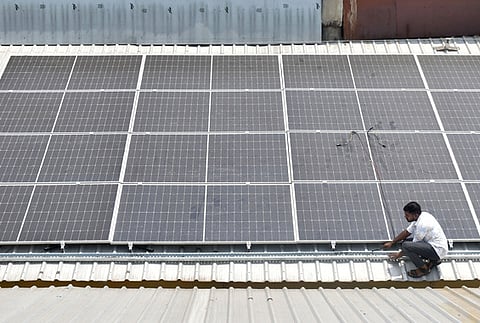

NEW DELHI: The reduction of Goods and Services Tax (GST) on key renewable energy equipment such as solar cells, biogas plants, windmill components, and solar lamps—from 12% to 5%—is expected to bring down capital costs for solar and wind power projects by approximately 5%. Industry experts say the move will reduce costs for ongoing projects and is likely to impact pricing in upcoming bids.
According to industry analysts, the reduced GST will help Indian companies ramp up local manufacturing of solar panels and other green energy components, decreasing dependence on imports—particularly from China.
“The rationalisation of GST rates for solar PV modules and wind turbine generators is expected to reduce the capital cost for solar and wind power projects by around 5%. This, in turn, is likely to lower the cost of generation by approximately ₹0.10 per unit for solar power and ₹0.15–₹0.17 per unit for wind power. The benefits will extend to projects currently under implementation and will likely reflect in future bids. Ultimately, this will help reduce the power purchase cost for distribution companies,” said Girishkumar Kadam, Senior Vice President & Group Head, ICRA Ltd.
Sumant Sinha, Founder, Chairman and CEO of ReNew, highlighted that the reduction of GST rates on solar equipment and batteries from 12% to 5% will lower electricity costs, enhance industrial competitiveness, and accelerate India’s clean energy transition.
“The removal of the compensation cess on coal and its merger into an 18% GST rate will also reduce the cost of thermal power. Broader GST rationalisation will stimulate domestic consumption and support export sectors, marking a decisive step toward a more efficient, resilient, and inclusive economy,” he added.
Sharad Mahendra, Joint MD & CEO of JSW Energy, noted that the GST reduction will have a positive impact not just on renewables but also on the company’s thermal power portfolio. “The removal of the compensation cess of ₹400 per tonne on coal—particularly domestic coal—will help lower fuel costs, reducing the cost of thermal power. This will help lower base-load power costs for the country and improve the financial health of distribution companies,” he said.
Some renewable energy items currently face an inverted duty structure, where raw materials are taxed at a higher rate than finished products. While the 5% GST widens this gap, companies can claim refunds on the excess taxes paid. The government has assured that the refund process will be expedited.
Although GST on coal has increased from 5% to 18%, the removal of the compensation cess means the overall cost of coal is not expected to rise significantly. As a result, electricity tariffs from coal-based power plants are likely to remain stable. Vineet Mittal, Chairman of Avaada Group, is of the view that the reduction of GST on solar cells from 12% to 5% will provide a significant boost to the domestic supply chain and support broader decarbonisation efforts.
