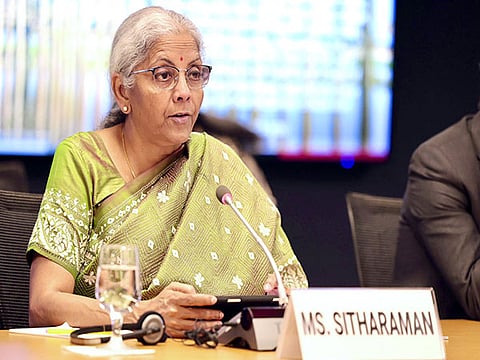

NEW DELHI – Finance Minister Nirmala Sitharaman emphasised the critical role of quality management and skill development in making India a globally competitive powerhouse. Speaking at the IFQM Symposium on Quality and Innovation, Sitharaman stated that the country's path to global leadership depends not just on infrastructure but on a "seasoned understanding of quality management."
"I am reassured that our path towards global leadership is not going to rest only on infrastructure creation or incremental improvements," she said, stressing the importance of interventions in manufacturing and services.
Government Initiatives and the AI Push
Sitharaman detailed several government initiatives aimed at fostering a culture of quality and innovation. She noted that in recent years, every government project has included provisions for skilling and upskilling the workforce. A major focus is the upgrade of the nation's 750 Industrial Training Institutes (ITIs).
"The Centre has offered full financial support to upgrade these ITIs into AI-driven training hubs," she announced. These upgraded ITIs will provide foundational AI skills to a wide range of individuals, from school dropouts to diploma holders, ensuring they can participate in the new economy.
In parallel, the government is leveraging institutions of excellence like the Indian Institutes of Technology (IITs) and the Indian Institute of Science (IISc) to lead AI-related research and development. These premier institutions will focus on four key sectors: agriculture, health, education, and urban development, with space and nuclear technology recently added.
Sitharaman highlighted the enthusiasm of state governments, noting that Andhra Pradesh, Maharashtra, and Gujarat have expressed readiness to establish local AI hubs tailored to their specific needs.
Empowering MSMEs
The Finance Minister also underscored the significance of the MSME (Micro, Small, and Medium Enterprises) sector, which is a vital contributor to India's GDP. To support these enterprises, the government has ensured that the Small Industries Development Bank of India (SIDBI) maintains a physical presence in identified clusters, guaranteeing easy access to credit.
Training programs, designed around local industry needs, have already been launched in approximately 150 clusters. This unique model not only trains workers for internal needs but also creates a surplus of skilled labor for the broader market, addressing a key challenge faced by industry leaders.
Sitharaman also pointed to strong international collaboration, particularly with Singapore, on certified vocational training. "In India-Singapore roundtables, both sides have recognized that quality management and productivity gains must go hand in hand," she stated.
Concluding her address, Sitharaman called the symposium "timely" and emphasized the need to act on its recommendations to fully capitalize on India's demographic dividend.
