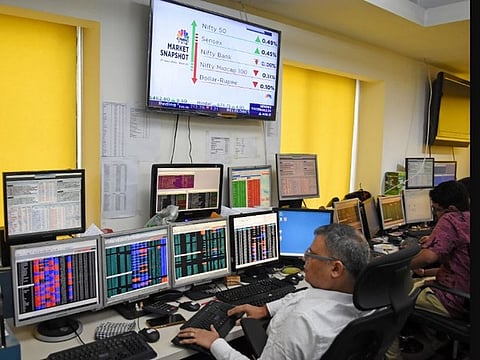

CHENNAI: Indian equity benchmarks ended lower on Friday, snapping a brief recovery seen earlier this week. The Sensex fell about 388 points, or 0.5 percent, while the Nifty slipped 0.38 percent, weighed down by weakness in auto, consumer durables, media, and IT stocks. Power and PSU banks were among the few sectors to close in positive territory.
The rupee closed nearly flat at 88.09 against the US dollar after a volatile session, tracking mixed Asian peers and steady crude oil prices. Currency traders noted that strong US Treasury yields and persistent foreign outflows kept pressure on the domestic unit. Resistance is seen around 87.75–87.80, with support near 88.45, indicating the near-term bias remains towards depreciation.
Gold prices continued their upward momentum. Internationally, spot prices held firm as investors positioned for a fifth straight week of gains, supported by expectations of further US Federal Reserve rate cuts. In India, gold hovered close to record highs of around Rs 1,09,870 per 10 grams for 24-karat, with festive demand and a weaker rupee amplifying the bullish trend.
In overseas markets, US stock futures pointed to a positive start as Wall Street digested the Fed’s latest rate cut and its guidance on further easing in October and December. Rate-sensitive sectors such as housing and consumer discretionary are expected to benefit, although investors remain cautious over the Fed’s relatively guarded tone.
Analysts say Indian equities could see limited upside unless foreign inflows pick up and the rupee stabilizes. A weaker currency may also stoke import-led inflation, adding pressure on margins for companies reliant on raw material imports. Meanwhile, gold is expected to remain supported in both global and domestic markets, driven by safe-haven demand, monetary easing expectations, and seasonal buying.
The short-term outlook for Indian markets hinges on global risk appetite, the pace of foreign capital flows, and upcoming U.S. economic data that will shape expectations around the Fed’s policy path.
