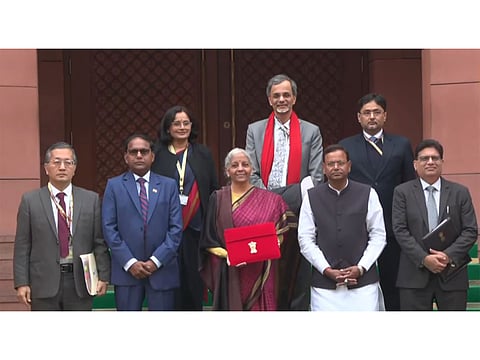

When Finance Minister Nirmala Sitharaman rises to present the Budget today, she will be aware of the dichotomy confronting the Indian economy. Headline indicators — GDP growth, inflation, and fiscal metrics — suggest that all is well. Yet another set of signals — a sliding rupee, FII outflows, slowing FDI, and softer revenue collections — paint a far less reassuring picture. This is not a moment for a non-event Budget. The inertia that seems to have crept into parts of the economy calls for a clear policy push.
Non-financial sector reforms
A push for next-generation reforms is a typical response in such circumstances. Sources indicate that the government may be lining up a set of non-financial sector reforms, having already advanced financial sector changes in FY26 through direct intervention and regulatory action. NITI Aayog is believed to have been working with several ministries on more than 40 such reforms, which have reportedly also been vetted by the PMO. The precise contours are not yet known, but it will be interesting to see whether the Budget signals movement on any of these fronts.
Cushion for exporters
With uncertainty continuing to cloud global trade, the Budget is expected to undertake a long-pending overhaul of the customs duty structure to help exporters cope with elevated US tariffs and disruptions in global supply chains. While the government can take comfort from having concluded FTAs with the UK and the European Union, it cannot afford complacency. It is unlikely that these agreements will come into force in 2026, leaving exporters to navigate near-term challenges largely on their own.
Tax certainty
The Finance Minister also needs to address the persistent outflow of foreign investor funds. Some relief — through a cut in capital gains tax or a reduction in the securities transaction tax (STT) — could help sentiment. Concerns around tax certainty resurfaced after the Supreme Court denied treaty benefits to Tiger Global on capital gains from the 2018 sale of Flipkart shares. The ruling has unsettled sections of the foreign investor community, particularly venture capital and private equity funds. A clear assurance from the government in the Budget could help restore confidence.
Walking the fiscal tightrope
Last year’s two major tax reforms — changes in income tax and GST rate rationalisation — have come at a fiscal cost. Income tax collections have been muted, and GST growth is already showing signs of slowing. Private investment has picked up but remains far from robust. In the absence of a strong private investment cycle, the government may need to step in, even as it remains committed to fiscal consolidation with limited room to manoeuvre.
Given these challenges, the Budget must resist being swayed by the “Goldilocks economy” narrative of moderate growth and low inflation. The Economic Survey 2025–26 has raised the medium-term GDP growth estimate to 7% from 6.5%, but the broader sense of optimism is still elusive. The key question is whether this Budget can help change that mood.