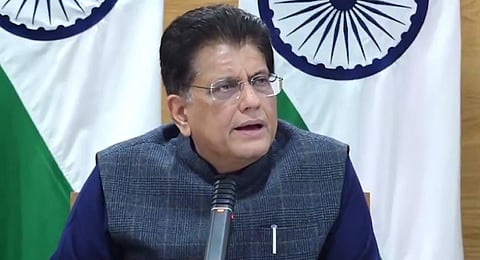

NEW DELHI: Commerce and Industry Minister Piyush Goyal on Saturday said India has made no concessions in the interim trade framework with the United States that would hurt domestic farmers, seeking to counter concerns raised by some trade experts over agricultural tariff cuts.
"Agricultural products from Indian farmers will be exported to the United States at zero duty. At the same time, no tariff concessions have been granted for agricultural products from US farmers entering the Indian market," Goyal said.
"We’ve not done anything that could affect the farmers of India. No genetically modified items will be imported to India. No relief or concession has been given on dairy, maize, soya meal, sugar, millets, citrus fruits," the commerce minister added.
Meanwhile, Goyal said several Indian products would attract zero duty, including gems and diamonds, pharmaceuticals—worth about USD 13 billion in exports—and smartphones.
In agriculture, many Indian exports would also face zero reciprocal tariffs, with additional duties removed, he said.
These include spices, tea, coffee, coconut and coconut oil, cashew and areca nuts, and fruits and vegetables such as mango, banana, guava, kiwi, papaya, pineapple, avocado and mushrooms.
Other items covered include barley, canary seeds, bakery products, sesame and poppy seeds, processed foods, banana pulp, citrus juices, mango and guava paste, and pineapple jam. Overall, reciprocal tariffs on these farm products would be cut from 50% to zero, he said.
His remarks come amid a debate triggered by a February 6 joint statement that outlined India’s commitment to reduce or eliminate tariffs on a range of US industrial goods and several agricultural products as part of the interim arrangement, which will feed into a future Bilateral Trade Agreement (BTA).
A note by the Global Trade Research Initiative (GTRI) flagged that tariff cuts on items such as US fruits and soybean oil could hurt Indian farmers and provoke domestic opposition. The note also said it was unclear which “additional agricultural products” were included for tariff reductions.
Goyal’s statement directly addresses these concerns, making clear that key politically sensitive farm segments—including dairy, maize, soya meal, sugar, millets and citrus fruits—remain protected and that India will not permit the import of genetically modified food items.
The joint statement listed products such as dried distillers’ grains (DDGs), red sorghum for animal feed, tree nuts, fresh and processed fruits, soybean oil, wine and spirits among those where India would consider tariff reductions. However, the precise product lines and modalities are yet to be detailed in the final interim agreement.
Trade experts have warned that concessions on fruits such as apples and oranges and on soybean oil could affect farmer incomes. Goyal’s clarification suggests that several of these sensitive categories may either be excluded or subject to safeguards in the final text.
Officials have maintained that the interim framework provides immediate relief to exporters in sectors such as textiles, leather, footwear, chemicals and handicrafts, while protecting core domestic interests.
