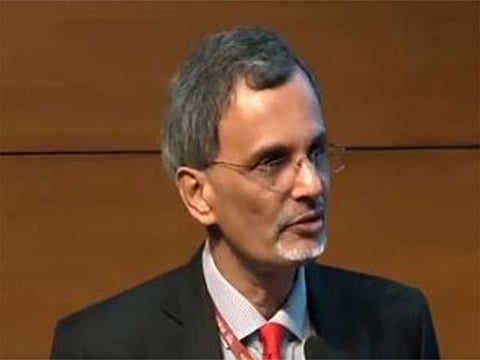

NEW DELHI: AI adoption cannot happen by drift and requires a clear commitment to aligning technological progress with mass employability, said V Anantha Nageswaran, India’s Chief Economic Advisor, on Monday. Nageswaran, while speaking virtually at the India AI Impact Summit in Delhi, emphasised that artificial intelligence could either strengthen India’s development vision or weaken it, depending on how it is implemented.
"With foresight, institutional discipline, and relentless execution, India can become the first large society to demonstrate true human abundance. Artificial intelligence can either reinforce this vision or undermine it -- the outcome will not be accidental," he said.
Nageswaran stressed that this transformation "will not happen by drift" and requires political will as well as strong state capacity. He underscored that the responsibility does not lie with the government alone, calling instead for a coordinated “Team India” approach that brings together policymakers, industry leaders, educators, academics and society at large. Adopting AI, he said, must be a collaborative national effort involving the private sector and academia alongside the government.
"The window is open still, but it is not indefinite. We must act and act now," he said, highlighting the urgency of embracing AI-driven change. "For India, it is not a debate about the future of work, it is a decision about the future of growth and social stability," Nageswaran said.
Reiterating his broader vision, he said, "With foresight, institutional discipline, and relentless execution, India can become the first large society to demonstrate true human abundance."
While noting that millions of jobs are created in India each year, Nageswaran pointed out that a significant skills gap remains, with only a small proportion of the workforce having received formal training. "This gap is not just statistics, it's a structural vulnerability," he said.
To address this vulnerability, he called for a decisive shift in policy focus to better align education, skilling and technological adoption with the country’s long-term economic and social objectives.
