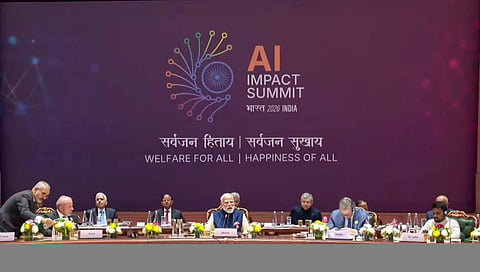

NEW DELHI: Around 88 countries, including the US, UK, China and those in the EU, along with several international organisations, have endorsed the AI Impact Summit Declaration at the conclusion of the India AI Impact Summit 2026 in Delhi.
The five-day event, which saw the largest gathering of top AI CEOs and heads of countries, endorsed a shared vision for Artificial Intelligence governance and development.
“We, the participants from countries and international organizations, gathered in New Delhi on 19 February 2026 to hold the AI Impact Summit. The advent of AI marks an inflection point in the trajectory of technological evolution. The choices that we make today will shape the AI-enabled world that future generations will inherit,” reads the declaration.
According to the statement, the declaration is structured around seven key pillars forming the foundation of global AI cooperation, including Democratizing AI Resources, Economic Growth & Social Good, Secure & Trusted AI, AI for Science, Access for Social Empowerment, Human Capital Development, and Resilient, Efficient & Innovative AI Systems.
The declaration promotes affordable access to foundational AI resources, including support for locally relevant innovation ecosystems. It also envisages a platform to scale and replicate AI use cases globally and enable cross-country collaboration for development impact. It further supports the development of secure and trustworthy AI systems, as well as AI skilling, reskilling and literacy initiatives to prepare nations for an AI-driven economy.
“Wide-scale adoption of AI and AI-based applications hold unprecedented potential to drive economic and social development. Open-source AI applications and other accessible AI approaches, where appropriate, and wide-scale diffusion of AI use cases can contribute to scalability, replicability, and adaptability of AI systems across sectors,” reads the statement.
It further noted that recognising the growing demands of AI on energy, infrastructure and natural resources, the participants underscore the importance of developing energy-efficient AI systems. Affordable AI systems may expand access to AI and accelerate local innovation that would advance shared developmental aspirations.
Inspired by the Indian principle of “Sarvajan Hitaya, Sarvajan Sukhaya” (Welfare for All, Happiness for All), the declaration emphasizes that the benefits of AI must be equitably shared across nations and communities. Participants described AI as an inflection point in technological evolution and called for strengthened international cooperation and multistakeholder engagement, while underscoring respect for national sovereignty.
The summit also unveiled several collaborative global initiatives designed to operationalize the declaration’s goals, including a Charter for the Democratic Diffusion of AI to promote affordable access to foundational AI resources and strengthen local innovation ecosystems; the Global AI Impact Commons to scale and replicate successful AI use cases across countries; the Trusted AI Commons as a repository of tools, benchmarks and best practices; an International Network of AI for Science Institutions to enhance cross-border research collaboration; an AI Workforce Development Playbook and Reskilling Principles to prepare economies for AI-driven transformation; and Guiding Principles on Resilient and Efficient AI accompanied by a Playbook on AI Infrastructure Resilience.
All initiatives are voluntary and non-binding, reflecting a cooperative rather than regulatory approach to global AI governance. The declaration highlights AI’s transformative potential in driving economic productivity, public service delivery and scientific advancement, while also acknowledging the growing energy and infrastructure demands of AI systems and calling for energy-efficient design and resilient infrastructure.
Participants reaffirmed their commitment to translating shared aspirations into concrete action through continued collaboration. The AI Impact Summit Declaration is annexed to the official communiqué and is expected to catalyse long-term international partnerships, positioning AI as a central driver of sustainable economic growth and social development in the coming decades.
The last summit held at Paris in 2025 had about 60 signatories in the final declaration.
