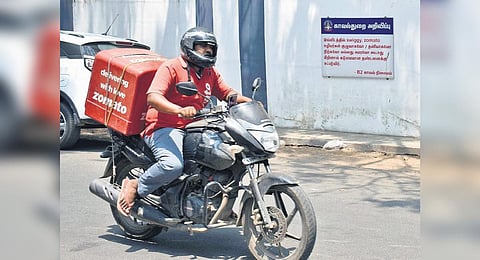

Even as the debate around gig workers’ earnings refuses to die down, HR and staffing solution companies point to wide disparities in monthly average incomes and tough work conditions leading to high attrition rate. While Eternal founder Deepinder Goyal has claimed that a delivery partner can earn over Rs 25,000 a month on average, workers’ unions contest this, saying that on a normal day gig workers earn just Rs 6–Rs11 per delivery. They also note that many food delivery platforms initially paid as much as Rs 50 per delivery.
A back-of-the-envelope calculation by The New Indian Express suggests that, on average, food delivery partners of Eternal (formerly Zomato) earn about Rs13,800 a month, based on data as of September 30, 2025. A year ago, this figure was around Rs10,000. Actual payouts, however, vary significantly: partners who put in longer hours can earn upwards of Rs50,000 a month.
In a social media post, Goyal said: “In 2025, average earnings per hour (EPH), excluding tips, for a delivery partner on Zomato were Rs102. In 2024, this number was Rs92, a 10.9% year-on-year increase. Over a longer horizon also, EPH has shown steady growth.”
According to a CIEL HR study, 70% of gig workers earn less than Rs50,000 a month, 29% earn up to Rs25,000 and 41% earn between Rs25,000 and Rs50,000. About 21% earn Rs50,000-₹80,000, while 9% earn more than Rs80,000 a month.
While there is a general perception that gig workers earn between Rs20,000 and Rs28,000 a month, Manoj Yadav, Maharashtra general secretary of the All India Gig Workers’ Union, disputes this. “On a normal day, gig workers get Rs6– Rs11 per delivery. However, this varies significantly by city, hours worked, incentives and fuel costs,” he says. On high-demand days, incentives can be as high as 100% of delivery charges. For instance, on December 31, delivery partners could earn an additional Rs 6-Rs11 per delivery as incentives.
Staffing firms also point out that the gig economy sees the highest attrition rates in the employment market. Aditya Narayan Mishra, CEO & MD of CIEL HR Services, says attrition among gig workers is around 15–18% every month, translating to nearly 180% annually. “This is largely because gig work is flexible by design, and many workers find it difficult to adapt to on-ground realities,” he says.
Balasubramanian A, senior vice-president at TeamLease Services, estimates monthly attrition in the gig workforce at 40–50%. “This is primarily driven by the flexible nature of gig work, income volatility, seasonal demand shifts, and workers moving between platforms in search of better payouts or incentives,” he says.
Beyond pay, unions continue to demand better insurance and social security coverage. In its regulatory filings, Eternal has highlighted the provision of free accident, death and health insurance, stating that claims worth over ₹160 crore have been processed over the past four years.
However, Yadav counters this claim, saying workers are covered only under group insurance and are not provided adequate accident cover. “Many workers don’t even know the details of the insurance,” he says. He has also demanded a ban on the 10-minute quick-commerce model, arguing that workers are losing their lives in the “race to deliver in no time”.
Echoing similar concerns, Sunand, president of the Rajdhani App-based Workers’ Union, says: “The 10-minute delivery system is harmful to the health and safety of workers, as well as to petty traders and employees of small retail shops. It needs regulation. The dark stores that underpin this system also need to be regulated.”
Meanwhile, the Labour Ministry has proposed a 90-day annual work threshold as the mandatory eligibility criterion for gig and platform workers to access social security under the draft rules of the Social Security Code, 2020.
Alay Razvi, managing partner at Accord Juris, believes the provision misses the mark. “The 90-day eligibility requirement is well-intentioned but misaligned with ground realities. Gig work is typically intermittent, multi-platform and seasonal. Many workers log in for a few weeks, pause, switch platforms, or combine gig work with other occupations. Expecting continuous engagement for 90 days with an aggregator risks excluding precisely those workers the law aims to protect,” he says.
