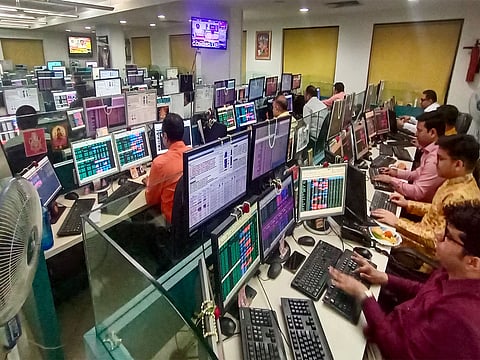

CHENNAI: Indian equity markets were largely range-bound in mid-morning trade on Friday, January 9, 2026, as investors remained cautious after the recent sell-off and ahead of key global cues. Benchmark indices struggled to hold early gains, reflecting a lack of strong conviction on either side and continued nervousness over global trade and policy developments.
The Sensex hovered around the 84,000 mark, slipping in and out of marginal losses, while the Nifty 50 traded slightly below the 25,900 level. After opening on a mildly positive note, both indices saw selling pressure emerge at higher levels, indicating that traders were using intraday rallies to trim positions rather than build fresh exposure. Market breadth was tilted towards the negative, with declines outnumbering advances, underscoring the cautious undertone prevailing across the broader market.
By around 12.30 noon, the Sensex was trading close to the 84,100 level, down marginally on the day, while the Nifty 50 hovered near 25,850, continuing to move in a narrow range with a mild negative bias as cautious sentiment persisted.
Sectoral performance remained mixed through the mid-morning session. Realty stocks were among the weakest performers, extending recent losses as higher interest rate concerns and profit-taking weighed on sentiment. Select private banking and financial stocks also traded with a soft bias, contributing to the lack of momentum in the benchmarks. In contrast, information technology stocks showed relative resilience, supported by defensive buying amid global uncertainty and expectations of stable demand from overseas clients. Some public sector bank stocks also attracted selective interest, helping to limit the downside.
The broader market continued to underperform the frontline indices, with mid-cap and small-cap stocks facing intermittent selling pressure. This reflected investors’ preference for relatively safer, large-cap names amid heightened uncertainty. Traders remained wary after several sessions of declines, and the absence of strong domestic triggers kept activity largely driven by global cues.
From a macro and global perspective, uncertainty surrounding potential trade actions by the United States and their broader implications for global growth continued to weigh on risk appetite. Persistent foreign portfolio investor selling in recent sessions has also dented confidence, with overseas investors remaining cautious on emerging markets. At the same time, the rupee’s movement and trends in global bond yields were being closely watched for cues on near-term market direction.
Technically, analysts pointed out that the Nifty’s inability to decisively reclaim the 26,000 level has kept near-term sentiment fragile. The index continues to trade below key short-term averages, suggesting that the market may remain vulnerable to further bouts of volatility unless sustained buying emerges. For the Sensex as well, resistance at higher levels has capped upside attempts, reinforcing expectations of a consolidation phase.
Overall, the mid-morning trade on Friday reflected a market in wait-and-watch mode, balancing domestic valuation concerns with global uncertainty. Unless there is a strong trigger later in the session, participants expect markets to remain range-bound, with stock-specific action and sectoral rotation dominating trade rather than a broad-based directional move.
