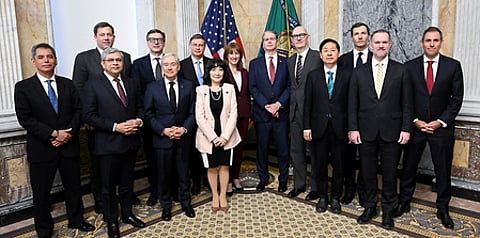

NEW DELHI: Participants from various countries discussed funding for new projects to build a resilient supply chain for critical minerals, said Minister for Electronics and Information Technology Ashwini Vaishnaw said on Tuesday.
The minister, who attended a ministerial meeting organised by US Treasury Secretary Scott Bessent, said the discussions focused on strengthening the resilience of critical minerals supply chains. He added that there were also deliberations on recycling and technology sharing among countries to ensure a seamless supply of critical minerals.
Vaishnaw emphasised that a resilient supply chain is crucial, particularly for India, where the manufacturing sector—especially electronics manufacturing—is growing rapidly.
“In this meeting, participants from various countries discuss their experience, the steps that they are taking in making the supply chain resilient, especially technology for refining and processing the mineral ores so that high-quality critical minerals, especially the rare earth, permanent magnets can be secured in the long term in a sustainable manner,” said the minister.
The ministerial meeting, involving G7 nations and other countries including India, aims to reduce dependence on China for rare earths and their processing, amid China’s export restrictions. China currently accounts for approximately 60–70% of global rare earth mine production. China has not imposed a blanket refusal or outright ban on supplying rare earth materials globally. However, it has repeatedly used export controls—primarily through mandatory licensing requirements—to restrict, delay, or selectively limit supplies, often in response to geopolitical tensions. This has resulted in de facto refusals for certain buyers, end uses, or countries.
The minister further said that discussions also covered funding for new projects and technology sharing among participating nations. Recycling emerged as a key focus area, as it offers an effective way to extract minerals from waste products.
“There were discussions and agreements around sharing research work among different countries. It was a very positive meeting in which the thought process was to improve the quality and availability of critical minerals,” said the minister.
