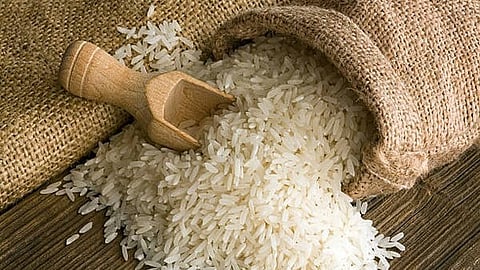

CHANDIGARH: The Indian Basmati rice exporters have temporarily halted shipments to Iran in view of the deteriorating situation there. The suspension of export is temporary and done as a precautionary measure.
However, the suspension in export has led to a drop in the prices of basmati rice in the domestic market. If a quintal on an average costs Rs 8,000, the price has dropped by around Rs 300 to Rs 800.
The exporters face payment delays and mounting uncertainties over the last six days. All channels of communication with Iranian importers are completely shut. This has made exporters to coordinate shipments or receive payment confirmations difficult.
Iran has traditionally been one of the second-largest and most reliable markets for Indian basmati rice.
India exported USD 468.10 worth of basmati rice to Iran during April-November of 2025-26 fiscal, totalling 5.99 lakh tonnes, trade data showed.
Talking to The New Indian Express, Ranjit Singh Jossan, governing member of the Basmati Rice Millers and Exporters Association said that the crisis is not limited to direct trade with Iran alone. The trade through Iran has also been hit.
"Transit trade through Iran especially via the strategic Bandar Abbas port, a crucial route for Afghanistan, Turkey, and Russia has also been severely affected. Ongoing instability has forced a halt to shipments through this corridor, further straining global supply chains and disrupting the movement of several Indian commodities, including basmati rice.’’
"If communication with Iran is not restored soon and tangible outcomes do not emerge from India US trade talks, the basmati industry could face a severe financial crisis in the coming days, with long-term repercussions for farmers, millers, and exporters alike,’’ he said.
India exports rice, tea, sugar, medicines, and machinery to Iran, while importing dry fruits, organic and inorganic chemicals, and glassware from Iran, he said.
The situation has worsened further with US President Donald Trump declaring imposition of 25 percent tariff for countries trading with Iran.
India–Iran trade relations have a long and significant history, with basmati rice remaining one of India’s most important exports to Iran. However, the steady decline in bilateral trade from a peak of USD 17.03 billion in 2018–19 to USD 1.68 billion in 2024–25 clearly reflects growing geopolitical and economic pressures.
Jossan added,`` For the basmati sector, the current phase is extremely sensitive. The Iran crisis, complete communication shutdowns, halted shipments, softening domestic prices, and looming threats of higher US tariffs together pose a serious challenge. In my view, without timely caution, market diversification, and strong diplomatic intervention at the government level, the long-term impact could be damaging for farmers, millers, and exporters alike.’’
Meanwhile the Indian Rice Exporters Federation (IREF) urged exporters to reassess risks on Iranian contracts and adopt secured payment mechanisms, warning against over-leveraging inventories meant for the Iranian market.
"Iran has historically been a pillar market for Indian basmati. However, the current internal turmoil has disrupted trade channels, slowed payments and dented buyer confidence,’’ said IREF National President Prem Garg and added that the exporters must exercise heightened caution, particularly with respect to credit exposure and shipment timelines.
Importers have conveyed their inability to honour existing commitments and remit payments to India, creating uncertainty for exporters. An advisory has been issued by the IREF and appealed to stakeholders to diversify into alternative markets across West Asia, Africa and Europe to cushion any prolonged slowdown in Iran-bound shipments.
`` We are not sounding an alarm, but urging prudence. In periods of geopolitical and internal instability, trade is often the first casualty. A calibrated approach is essential to protect both exporters and farmers," Garg said.
