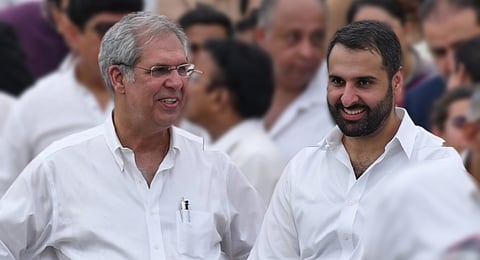

Neville Tata’s induction into the board of the Sir Ratan Tata Trust marks a significant moment in the evolving leadership architecture of the Tata Trusts and signals the steady emergence of a new generation within one of India’s most influential philanthropic and corporate institutions. The move comes at a time when the trusts, which together control a majority stake in Tata Sons and thereby exert decisive influence over the Tata Group, are in the midst of a broader generational and governance transition following changes in their senior leadership over the past year.
The Sir Ratan Tata Trust is one of the two principal trusts under the Tata Trusts umbrella, the other being the Sir Dorabji Tata Trust. These two entities together form the financial and governance backbone of the Tata philanthropic structure, with their shareholding in Tata Sons giving them a powerful voice in the strategic direction of the group’s operating companies as well as in the stewardship of the group’s social and charitable activities. Neville Tata’s entry into the Sir Ratan Tata Trust board follows his earlier induction into the Sir Dorabji Tata Trust, a progression that effectively places him within the core circle of trustees who shape both philanthropic priorities and the governance of India’s largest business house.
The decision to bring Neville onto the Sir Ratan Tata Trust board also strengthens the position of his father, Noel Tata, who currently serves as chairman of Tata Trusts. With Neville now straddling multiple key trusts, the Noel Tata branch of the Tata family consolidates a greater presence across the two most powerful trust boards, a development that has drawn attention within corporate and governance circles. While Tata Trusts have historically balanced professional trustees with family-linked members, the growing involvement of the younger generation is being seen as part of a deliberate effort to ensure continuity and long-term stewardship in an organisation whose influence stretches across industries, markets and social sectors.
Neville Tata is part of the third generation of the Tata family to be involved in the group’s institutional framework. He is the son of Noel Tata and the grandson of Simone Tata, who played a seminal role in building the Tata Group’s retail and lifestyle businesses in India. Educated at Bayes Business School in London, Neville returned to India to join the Tata Group in 2016 through Trent, the group’s retail arm chaired by his father. Over the past several years, he has worked across multiple facets of Trent’s operations, gaining hands-on exposure to store formats, supply chains and consumer-facing businesses. He currently heads Star Bazaar, the hypermarket and grocery retail business of Trent, which is central to the group’s ambitions in India’s fast-growing organised food and essentials market.
Within the Tata Trusts network, Neville has already been serving as a trustee on several smaller and mid-sized trusts, including the JRD Tata Trust, the RD Tata Trust and the Tata Social Welfare Trust. These roles have given him exposure to the philanthropic side of the group, which spans healthcare, education, rural development, research and social innovation. His earlier induction into the Sir Dorabji Tata Trust, followed now by his proposed or formalised entry into the Sir Ratan Tata Trust, represents a clear elevation into the most powerful tier of Tata’s trust-based governance structure.
The timing and trajectory of Neville Tata’s rise reflect a broader pattern in the Tata ecosystem, where the need for generational renewal has become more pressing. With several senior trustees having stepped down or aged out of active roles in recent years, the organisation has been looking to combine institutional memory with younger leadership that can engage with a rapidly changing business and social environment. Neville’s background in modern retail, consumer behaviour and large-scale operations is seen as a useful complement to the trusts’ expanding focus on sustainability, technology-driven social programmes and impact investing.
At a broader level, his induction underscores how the Tata Trusts continue to blend family stewardship with professional management. While the trusts are not run as family fiefdoms, the Tata lineage has historically provided continuity of values and long-term vision. By bringing Neville into the core trust boards, the organisation is effectively grooming him for a more prominent role in the future governance of both the philanthropic empire and, indirectly, the Tata Group’s corporate holding structure.
In practical terms, Neville Tata’s presence on the Sir Ratan Tata Trust board gives him a seat at the table where some of the most important decisions affecting the Tata ecosystem are made, ranging from trustee appointments and philanthropic allocations to the exercise of shareholder rights in Tata Sons. It places him among a small group of individuals who shape not only where the Tata Trusts deploy their vast resources but also how the group’s flagship companies are overseen.
Taken together, Neville Tata’s induction is more than a routine board change. It reflects the gradual but unmistakable passing of the baton to a younger generation within the Tata family, aligns with Noel Tata’s growing influence at the helm of Tata Trusts, and points to a future in which Neville is likely to play an increasingly central role in both the charitable and corporate governance landscape of the Tata Group.
