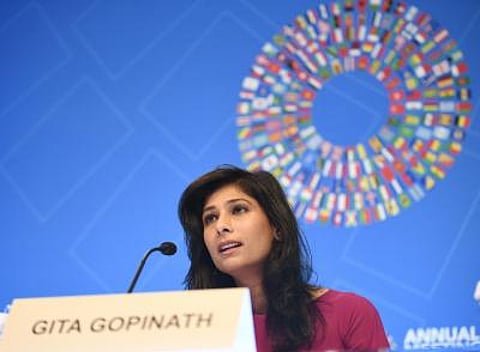

Pollution poses a far greater economic risk to India than trade tariffs or external protectionist measures, Harvard University professor and former IMF chief economist Gita Gopinath said at the World Economic Forum, underscoring environmental degradation as one of the country’s most pressing macroeconomic challenges.
Speaking at Davos, Gopinath said that while global trade tensions and tariffs often dominate policy debates, the economic costs of pollution for India are deeper, more persistent and harder to reverse. She described tackling pollution as a “top mission” for India, warning that unchecked environmental damage could significantly undermine productivity, health outcomes and long-term growth.
Her remarks come at a time when India is widely projected to become the world’s third-largest economy by 2028, driven by strong domestic demand, public infrastructure investment and a favourable demographic profile. However, Gopinath cautioned that aggregate economic size alone does not tell the full story, noting that improving per capita incomes remains a critical challenge for policymakers.
According to her, pollution directly affects labour productivity through adverse health impacts, raises healthcare costs and reduces the quality of life, particularly in urban and industrial centres. These effects, she said, ultimately slow the pace at which income gains translate into broader welfare improvements. In contrast, trade tariffs, while disruptive, tend to have more limited and often negotiable economic effects over time.
Gopinath highlighted that India’s rapid urbanisation and industrialisation have amplified environmental stresses, making pollution control not just a public health issue but a core economic priority. She stressed that sustained growth capable of lifting per capita incomes requires cleaner air, safer water and more resilient cities, alongside traditional growth drivers such as investment and innovation.
From an analytical perspective, the comments point to a growing recognition among global economists that environmental externalities can materially alter a country’s growth trajectory. For India, failure to address pollution could erode the demographic dividend by reducing workforce efficiency and increasing inequality, as lower-income households disproportionately bear the health and income costs of environmental degradation.
At the same time, addressing pollution presents an economic opportunity. Investments in clean energy, public transport, waste management and green technologies could create jobs, improve productivity and support more inclusive growth. Aligning environmental policy with economic strategy may therefore be essential if India is to convert headline GDP growth into meaningful gains in per capita income.
Gopinath’s remarks add weight to the argument that India’s next phase of growth will depend not only on scale but on quality. As the country moves closer to becoming a global economic heavyweight, the challenge for policymakers will be to ensure that environmental sustainability keeps pace with economic ambition, so that rising national output translates into healthier lives and higher incomes for its citizens.
