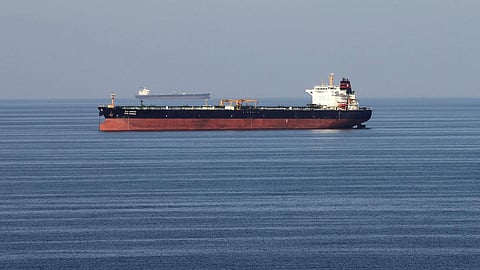

MUMBAI: If the Strait of Hormuz remains shut for long, this will have major implication for our economy as the all-important shipping passage carries almost half of the oil and gas from the Middle East to our shores. The impact is many-sided: it can push crude prices to $90-100 (already Brent is quoting $82.5 a barrel having shot by around 15% since the war began), can stoke inflation by 40 bps and shave 50 bps off GDP apart from pushing up current account deficit by 30-50 bps, many economists have warned.
At the last monetary policy review, the Reserve Bank has assumed crude oil basket price to average $70/barrel in fiscal 2026 for its inflation and growth assumptions. The RBI has forecast FY26 CPI at 2.1%, and at 4.1% in H1 of 2027 but if the war lingers on this would have to be revised upwards.
Since the war on Iran began last Saturday crude prices have shot more than 15% and the global benchmark Brent is quoting $82.5 a barrel Tuesday, up 3.3%, while the Iranian attack on Qatari LGN facility and the closure of the Strait of Hormuz has led to gas prices surging 55% in Europe. The Strait of Hormuz carries about 20% of the world's crude but has come to a standstill as Iran continues to rain missiles and drones across West Asia.
According to Kaushik Das, chief economist at Deutsche Bank India, for every $10/barrel increase in global oil prices, the country’s current account deficit could go up by 0.4% of GDP. Current account deficit could rise to $65 billion or 1.5% of GDP in FY27, as against the pre-war forecast of $45.6 billion or 1% of GDP.
“If it happens so, there will be continued depreciation pressure on the rupee, as foreign capital inflows remain weak, as the balance of payment will have a of $20 billion,” Das said but maintains the year-end rupee target at 90 as the 40-currency trade-weighted REER currently stands at 94.7 and given that there could be a de-escalation to the current tension over the coming months.
On CPI inflation Das said assuming a full pass-through, a 10-20% increase in global oil prices can potentially push up inflation by 25-50 bps. But if the rupee falls further, the impact could be higher.
He also doesn’t expect the government to pass on the impact of higher oil prices to consumers. “Only if oil prices rise sustainably to $100/barrel and alternate burden-sharing options have been availed, will the government probably consider passing on the impact of higher global oil prices partially to consumers.
“In case of a partial pass-through, CPI inflation could rise to 4.5-5% range in FY27 vs baseline assumption of 4.3%. However, we expect core CPI inflation and core CPI ex-precious metals inflation to remain contained, closer to the 4% target in FY27,” Das said.
On the other hand an analyst at Oxford Economics doesn’t see much of an impact saying the oil market is well supplied.
“The oil market is well supplied, and Iran is unlikely to sustain disruption that is both severe and prolonged, making a full-blown oil crisis unlikely. This is reflected in the market reaction: Brent rose to around $82/barrel on the initial shock before settling closer to $78, suggesting markets are pricing disruption, but not a prolonged closure that would trigger major shortages, ,” said Bridget Payne, head of energy forecasting at Oxford Economics.
Stating that a moderate disruption at the Strait of Hormuz has now become their baseline view, she said, “while the Strait remains technically open, transit has effectively paused because of security risks and prohibitive insurance costs.” Around a fifth of global oil and LNG transits the Strait each day worth over $1.3 billion including Iranian exports themselves, she noted.
According to Choon Hong Chua, a senior director at Moody’s, the larger impact of the closure of the Strait goes beyond oil but overall trade behaviour across Asia.
“Beyond the immediate risk to oil and gas supplies from the Gulf, the broader concern is how the conflict may influence trade behavior across Asia. As military actions intensify, countries are likely to align their trade and export control policies more explicitly with geopolitical positioning. This raises the risk of selective export restrictions, informal boycotts, and tighter customs scrutiny as governments seek to limit exposure to secondary sanctions or political repercussions,” Chua said.
The country meets as much as 85% of crude needs from imports and 45% of that are sourced from the Gulf only. So even moderate price spikes can quickly fuel transport cost. As much as 40% of the LNG is sourced from Qatar alone.
Economists at BMI warned that the long term closure of the Strait of Hormuz can offset the gains from the trade deals and can shave 50 bps off GDP.
“From March onwards, we expect uncertainty to increase sharply in India due to the ongoing conflict in the Middle East. We believe this will discourage investment, offsetting the positive effects from the trade deals on growth. Risks to our outlook are high and two-sided. Iran has issued threats to ships traversing the Straits of Hormuz. Our estimates suggests a full closure of the Straits of Hormuz could directly reduce GDP by up to 0.5 bps through higher energy costs,” analysts at BMI, a Fitch group entity, said Tuesday.
"A sharper escalation can push crude towards $90–100, if the Strait of Hormuz is disrupted for longer. This would raise inflation risk materially and can force tighter monetary conditions," said Manoranjan Sharma, chief economist at Infomerics Ratings.
"Higher oil prices act as a tax on net importers as it erodes households real disposable income and raises input costs for transport, aviation, chemicals, fertilisers and several manufacturing segments," Sharma added.
According to Gaura Sen Gupta, chief economist at IDFC First Bank, the impact of rising crude prices will impact the fiscal math only if it leads to a rise in LPG subsidy, decline in PSU dividends, and a potential rise in fertiliser subsidies.
