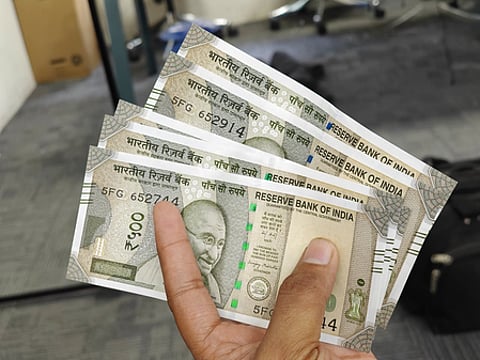

The rupee on Wednesday slipped to an all-time intra-day low of 95.80 against the US dollar before settling at 95.66, hovering near its record closing low, as elevated crude oil prices and geopolitical tensions in West Asia outweighed hopes of lower dollar demand following import curbs.
Forex traders said possible intervention by the RBI and a duty-led reduction in gold imports helped contain further weakness in the USD/INR pair. However, the rupee remained under pressure due to rising crude prices and uncertainty stemming from the West Asia situation.
According to traders, the rupee has emerged as the worst-performing Asian currency this year, weakening by more than 6 percent so far in 2026 amid elevated oil prices, a strong US dollar and concerns linked to the West Asia crisis.
At the interbank foreign exchange market, the rupee opened at 95.52, up 16 paise from its previous record closing low. In highly volatile trade, the domestic currency touched an intra-day high of 95.51 and a low of 95.80 against the greenback before ending the session at 95.66, up 2 paise from Tuesday’s close.
On Tuesday, the rupee had depreciated by 40 paise to settle at a fresh all-time closing low of 95.68 against the US dollar.
“On the rupee, USD/INR around 95.60 reflects the cumulative strain of elevated crude prices and the West Asia geopolitical premium. Active RBI intervention and the duty-led compression of gold imports should help moderate further weakness. The path of the rupee from here will be shaped less by gold and more by the trajectory of crude and the West Asia situation,” Anindya Banerjee, Head of Commodity and Currency Research at Kotak Securities, said.
The Indian government on Wednesday raised import tariffs on gold and silver to 15 per cent from 6 per cent in an attempt to curb overseas purchases of the precious metals and ease pressure on the country’s foreign exchange reserves.
Traders said the higher gold import duty could dampen domestic demand for the yellow metal in India, the world’s second-largest consumer of precious metals.
On Sunday, Prime Minister Narendra Modi urged people to avoid buying gold for a year to help conserve foreign exchange reserves, noting that India imports most of its gold requirements.
Meanwhile, the dollar index, which measures the greenback against a basket of six major currencies, was trading 0.22 per cent higher at 98.51.
“We expect the rupee to trade with a negative bias amid rising crude oil prices, concerns over inflation and geopolitical tensions between the US and Iran. However, any intervention by the RBI may support the rupee at lower levels. USD/INR spot price is expected to trade in a range of 95.45 to 96.15,” Anuj Choudhary, research analyst at Mirae Asset ShareKhan, said.
Brent crude, the global oil benchmark, declined 0.44 per cent to USD 107.30 per barrel in futures trade.
“Brent oil prices were stable at around USD 107 per barrel after rallying for three consecutive sessions, with traders assessing continued disruptions to shipping through the Strait of Hormuz and US inventory data,” Anil Kumar Bhansali, Head of Treasury and Executive Director at Finrex Treasury Advisors LLP, said.
On the domestic equity front, the Sensex ended 49.74 points higher at 74,608.98, while the Nifty gained 33.05 points to close at 23,412.60.
Foreign Institutional Investors (FIIs) sold equities worth Rs 4,703.15 crore on Wednesday, according to exchange data.
On the macroeconomic front, retail inflation edged up to 3.48 per cent in April, mainly due to higher prices of gold and silver jewellery as well as certain kitchen staples, according to government data released on Tuesday.
Consumer Price Index (CPI)-based inflation, with 2024 as the base year, stood at 3.40 per cent in March, 3.21 per cent in February and 2.74 per cent in January.
Data released by the National Statistics Office showed that food inflation rose to 4.20 per cent in April from 3.87 per cent in the previous month.
(With inputs from PTI)
