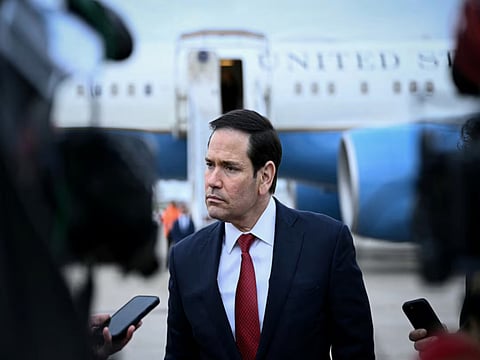

NEW DELHI: US State Secretary of State Marco Rubio used his first visit to India to push energy cooperation and steady a relationship strained by tariffs, shifting regional alignments and growing Indian unease over Washington’s engagement with both Pakistan and China.
Rubio’s talks with Prime Minister Narendra Modi came at a crucial geopolitical moment, with the Iran conflict disrupting global energy markets, uncertainty persisting over US trade policy, and New Delhi closely watching Washington’s recalibration of ties with Pakistan and China.
A US State Department readout of the meeting with Modi highlighted the energy focus of the visit, saying, “The Secretary emphasized that the United States will not let Iran hold the global energy market hostage and affirmed that US energy products have the potential to diversify India’s energy supply.”
The remarks reflected Washington’s attempt to position itself as a reliable energy partner for India at a time when volatility in the Gulf and disruptions around the Strait of Hormuz have renewed concerns over energy security. The Iran conflict has also complicated US efforts to reduce India’s dependence on discounted Russian crude, which became a major irritant in ties under the Trump administration. Ahead of the visit, Rubio made clear that energy exports would be central to the American pitch to India.
“Well, we want to sell them as much energy as they'll buy,” Rubio told reporters before arriving in India. “We want to be able to do more. We were already in talks with them to do more. We want them to be a bigger part of their portfolio.” He also pointed to “opportunities with Venezuelan oil”, signalling Washington’s broader effort to reshape India’s energy basket amid growing geopolitical uncertainty.
The outreach comes as the Trump administration attempts to repair damage caused by steep tariffs imposed on Indian goods last year, among the harshest levied on any US partner. While some duties were rolled back under an interim arrangement, talks on a comprehensive trade agreement remain stalled.
India has also grown increasingly wary of America’s simultaneous outreach to Pakistan, which has emerged as a key interlocutor in efforts surrounding the Iran conflict. Trump’s recent visit to Beijing further amplified concerns in New Delhi about the direction of US strategy in Asia.
Following his meeting with Modi, Rubio described India as a “cornerstone” of America’s Indo-Pacific approach and said the two countries were likely to make “even more exciting and new announcements” on strengthening ties in the months ahead.
