
The magic of the forests of Bhimashankar ensure that there is never a dull moment in the forest. During the day, the forest echoes with the calls of the Indian giant squirrel (Ratufa indica), which Bhimashankar is famous for. The shekru, as this is called locally, is a large squirrel that mostly stays up in the tree canopy.
My interest, mostly, is in what is closer to the ground — the creepy-crawlies! During one of my visits to Bhimashankar in April, I was especially keen to search for lizards. In this season, the ambient temperature of the surroundings permits these cold-blooded creatures to soak up warmth from the surroundings and the sun and stay active. At the same time, during this season, food is plentiful, as many other invertebrates, their main source food, are also breeding.
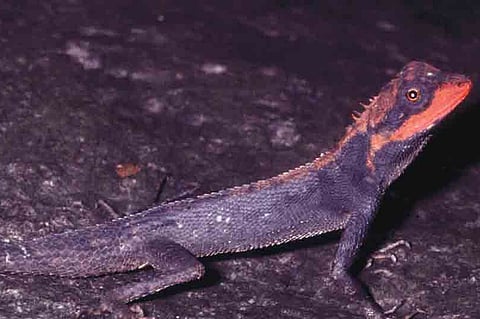
As I trudged along the forest tracks looking for lizards, the rustle of dry leaves on the ground was often the first indication of something afoot. The most common reptile that I encountered during this visit was a beautiful lizard called the forest calotes (Calotes rouxi). During the breeding season, the male of this type of lizard is black while its head and back are a lovely blood red. The lizard has a black mask over its eye, making it look like a bandit! The female of this lizard is a duller brown, with a series of black lines radiating from its eye, and a black patch on its shoulder.
The forest calotes is active during the day, and mainly hunts for insects on the ground and on bushes and trees. On one occasion, I watched a handsome male perched on a rock. A dragonfly settled on the rock close by and in a flash the lizard caught it in its mouth. The lizard scrambled up a tree with the dragonfly still in held firmly between its jaws;
‘I’m safe here,’ it seemed to say. And over the next few minutes, it chomped and swallowed the dragonfly!
On another occasion, I spotted a male lizard with its skin peeling. Did you know, that unlike humans, whose skin grows as we grow, the skin of reptiles does not? So as reptiles grow, they shed their skin. This is called moulting. The dry, unwanted skin peels off the reptile, leaving behind fresh, healthy skin.
Many lizards are known for their ability to change colour. These colour changes can occur almost instantly, but many lizards change colour with the seasons. During a visit to the Western Ghats in Karnataka in the monsoon month of August, I found a green lizard. Examining it closely led me to identify it as the forest calotes itself! During the wet months, the lizard adopts the colour of its surroundings in order to camouflage itself better!
Canny customer!
The forest calotes is found from Gujarat southwards to Kerala and Tamil Nadu, throughout the Western Ghats. It occupies forested habitat, so the next time you venture out to a forest near your home, be sure to keep your eyes and ears peeled; a forest calotes may just be waiting to say “Hello” to you!
Feedback and queries are welcome at sanjay.sondhi1@gmail.com