
Everyday crime and criminals are becoming smarter and more and more vicious. Thus, crime solving has to evolve and work harder than ever to keep up. Forensics is once branch of investigation that is integral to crime solving. A tiny hair, a drop of body fluid or a tooth mark can be used to incriminate a person. But it wasn’t this way always.
In the olden days, trials of criminals were based on two things — witnesses and forced confession. These were not the most reliable methods of determining the guilt of a person to which the Salem Witch Trials are a testimony. Also a method called trial by ordeal was used. Since science at that time was not very different from religion or magic, people’s innocence was ‘proven’ by painful methods of torture, for example: the suspect was tied to a chair and lowered into a body of water, if they drowned, like a normal person would, they were innocent and if they survived, then they were proven guilty and were put to death anyway.
Forensic sciences, though almost negligible then, did exist in little pockets around the world. One of the most famous incidents was Archimedes’ ‘Eureka’ moment. A Greek king was suspicious that the new crown the goldsmith made for him was not pure gold and so he ordered Archimedes to find out if his doubt was valid without damaging the crown in anyway. This event in history was not only a step forward for forensics but also for physics as in the process of determining if the goldsmith used silver to manufacture the crown, Archimedes discovered the principles of buoyancy, density, force and equilibrium.
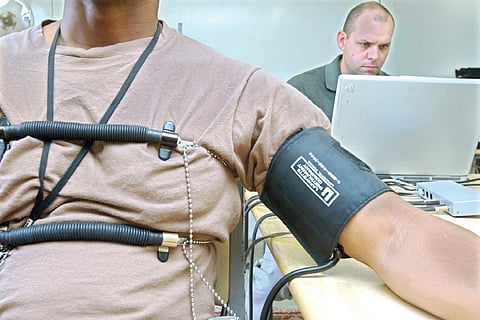
Though the polygraph, which is now used to measure physiological indices like blood pressure, pulse, respiration and perspiration, was invented as late as 1921, lie detection was a popular method of determining the guilt of suspects as early as 500 BC in ancient civilsations. In our very own country, some priests figured out a very good method of playing with psychology to weed out thieves from a bunch of people. They coated tails of a few donkeys with soot and shut them up with the suspects in a dark room. They told everyone that they had to hold the tail of a donkey and if it brayed they were guilty. Obviously the thieves were the ones who did not have blackened hands because they didn’t risk touching the tail.
In China, they told the suspect in custody to put some grains of rice in his mouth and then spit them out. The grains would ideally stick to the tongue because of saliva but people who are lying under stress tend to have a dry mouth and thus a liar was always detected because his grains flew right out.
Dactyloscopy, commonly known as fingerprint identification was scientifically presented to the world in the 18th century and is now used to prove guilt in a court of law, but even the ancient Babylonians knew that fingerprints are unique to every person. They used thumb prints as signatures to prevent forgery. In 300 BCE, ancient China, the handprint found at the scene of the crime did not match that of the suspect and proved his innocence.
Autopsies to determine the cause of death were not a favoured form of forensic science in the ancient world because of the belief that mutilation of the dead prevented them from moving on to the next world. Julius Caesar, the emperor of the Roman Empire, though had an official autopsy and it was determined that of the many stab wounds inflicted on him by the members of the forum, the second was the fatal one.
Now there are numerous branches of forensic science that are being used to bring criminals to justice.
They range from ballistics to blood splatter analysis to forensic pathology and many more. This very serious area of crime solving is being brought to the general public’s notice through fiction and also reinterpreted reality shows. Because the ‘general public’ also includes potential criminals, forensic science is moving and evolving even faster than we can imagine.