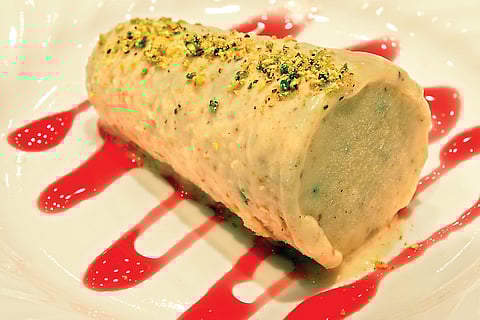

Summer has set in and its hold is ever expanding. We know global warming is to be blamed for the ever increasing levels on the thermometer. In this time of unbearable heat, humidity and dust, relief for us comes in many names and shapes but nothing beats the relief that a kulfi offers.
Is your mouth watering? I know mine is as I write this.
The word kulfi brings a whiff of freshness along with the tantalising aroma of cardamom, pistachio and roses. So let us begin the new chapter in our journey of exploration and see what the kulfi has to offer us.
Kulfi is believed to have been invented by the royal cooks in kingdoms situated near the Himalayas. These cooks are said to have discovered the method of freezing sweets and fruits to be served as dessert to the royalty. Later on, Mughal emperors are said to have shown a certain partiality towards kulfi after discovering the treat and are credited with popularising it amongst the masses. No doubt then that the kulfi in its purest form is full of dry fruit and everything else regal in the kitchen such as saffron and whole milk.
So what exactly are the contents of a kulfi? Kulfi is basically milk that has been cooked on a slow fire over a long period of time. The milk is flavoured with many choose-as-you-like ingredients these days and I must say that the range has widened since the time of Mughal emperors to a mind-boggling number of options.
Sample this — you have fruit syrups to give your kulfi the flavour of any fruit of your choice, be it mango or chikoo, orange or pineapple. Then there is the chocolate variant. For those with the more experimental palates there is even a gulab jamun flavoured kulfi available these days.
But by all accounts the basic kulfi flavoured with pistachio and other nuts remains the most popular one.
This creamy and dense frozen dessert is at times considered in a different league from ice creams. Kulfi is not whipped like an ice cream and due to its density, takes longer to melt than ice cream.
Two often heard synonyms of the kulfi are matka kulfi and falooda kulfi. The matka kulfi is just the good old kulfi frozen and sold in small little matkis or earthen pots. The falooda or the famous falooda kulfi is vermicelli or cornflour ‘sev’ that the kulfi is topped with and then coloured in lovely hues of red and pink with rose syrup poured on the sev.
A popular variation of falooda sev is a summer drink that also contains isabgol, cooling herbs like mint, jelly and tapioca pearls along with milk and water. Of course, a generous amount of rose syrup is used to give the dessert its colour and aroma.
Falooda is believed to have Persian origins. Wikipedia informs us that: A yakhchal was an ancient Persian ice house. By 400 BC Persians had developed the technique of storing ice.
The ice was gathered during winter or carried from the mountain tops in large insulated underground chambers topped by dome structures. This allowed ice to remain available throughout the summer, even in the desert. The best use was to prepare desserts like falooda. Later as techniques improved and evolved, rose water and sugar were added to vermicelli.
Here is a small nugget apart from all the lovely things that we have been discussing. Have you ever heard someone say izzat
ka falooda ho gaya? Falooda is used as a reference to something that has been shredded. Here it means that the honour has been shot or damaged.
I hope you have many creamy kulfis and the only thing to be shredded is the horrible heat.