
Cortes, the Spanish adventurer, considered the Aztecs to be an evil race because of their tradition of conducting human sacrifices on a massive scale. However, for the Aztecs, their rites were at the core of their beliefs. They believed that only if the gods were fed blood would the soil be fertile and rains return. They claimed that the victims, most of whom were prisoners taken in battle, went willingly to their deaths.
The killings were conducted with respect and veneration. The sacrifice blessed both the dying and the living and was a fate to be embraced.
The Aztecs were a warrior clan who through conquest had grown from a small tribe to a rich and powerful empire in just 150 years. Terror was one of their useful weapons. Moctezuma, whose name literally translates as ‘angry lord’, was as terrifying to his own people as he was to his foes. He was described as astute and learned but also harsh.
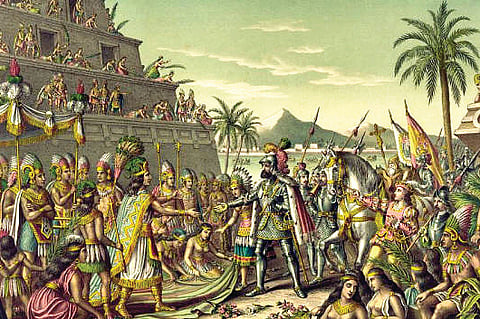
Why then did this tough and ruthless king, who had reigned for 18 years fall prey so easily to the invaders, allowing his fiercely independent people to be subjugated? The fact was that the Aztec ruler was utterly baffled by the newcomers, their tall ships, metal armour and horses — never before seen by them — he was at a loss to know how to deal with them. His armies could have easily defeated Cortes and his tiny army despite their advanced weaponry of steel swords and muskets. But he was beset by curiosity and a strange chivalry that made him want to be welcoming. Maybe he thought they were gods. He sent gifts, keen to impress them. But by being indecisive, he presented Cortes with enough time to scheme and plan. The Spaniard made pacts with rebellious towns that were ready to rebel against Moctezuma’s rule. He sacked one town that stood in his way, slaughtering the people and burning its temples before marching on towards the city in the lake, his army swollen by local recruits.
When Cortes arrived, Moctezuma mentioned how Aztec lore spoke of the return one day of a great overlord, to whom he would pledge allegiance.
Seizing on this, Cortes told the startled Aztec he came on behalf of just such a supreme emperor. Cortes invited him to submit to the overlordship of this emperor, which Moctezuma duly did.
For a while, relations were amicable. But they soured when Cortes’s men erected a Christian cross on the top of the Great Temple. As unrest grew, Cortes seized Moctezuma and held him captive in one of his palaces. He was allowed to carry on governing his lands but as a puppet ruler. Among the Aztecs, there was growing discontent. Priests were barred from temples and the idols of their gods replaced by images of Christ.
When priests and warriors crowded into the Great Temple for a religious festival, Cortes’s men perceived a threat. They sealed the doors and butchered thousands of them. Open warfare was about to break out, until Moctezuma was pressured to step in. He ordered his people not to attack and they reluctantly obeyed. But by this his sway over them was fatally undermined.
An uprising began in the city, led by Moctezuma’s brother. The Spaniards sent the captured ruler out on to a balcony to confront his people and make them withdraw. A volley of rocks and arrows came at him. He was hit in the face — the crucial blow said to be a stone hurled by his brother — and died three days later. However, historians believe that it was the Spaniards who killed him. With his authority gone, he was now expendable. They stabbed him to death.
Cortes and his men now left the city in a fighting retreat across the causeway and returned a year later with a reinforced army and took the Aztec capital after a bloody battle. In the name of the Emperor Charles V of Spain, he established himself as governor and captain-general of ‘New Spain’. He hanged Moctezuma’s brother, who had succeeded as ruler. The reign of the Aztecs was over. Much of their heritage was lost as the Spaniards looted the land. Friars arrived to convert the people. Spanish settlers came in increasing numbers.
But the blood line remained. Cortes had a child with Moctezuma’s sister. He married off some of his captains to the daughters of Aztec noblemen. From this integration, a new and distinctive Mexican nation began to emerge, part Spanish, part Aztec. The past was buried. Tenochtitlan was destroyed and a new city called Mexico city was built over it.