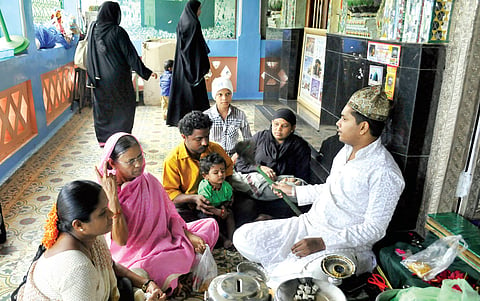

The Dance of Saint Antony: Indian Shrines as Therapeutic Sites, which was screened at NIMHANS earlier this week, made everyone present in the room cringe. The 30-minute documentary by Dr Brigitte Sebastia, medical anthropologist from Department of Social Sciences, French Institute of Pondicherry, illustrated the lives of people accessing St Antony’s Shrine in Puliyampatti, Tamil Nadu, for therapy, in detail.
It dealt with patients suffering from serious psychiatric illnesses such as schizophrenia, bi- or mono-polar disorder, mental retardation, somatic and depressive disorders due to traumas among others. The depiction clearly showed that more often than not these patients are tagged as ‘possessed’ and stay in the shrine for days together. The more violent ones are tied to trees by their family members. Women and men alike spin their heads over pots of fire, others scream out, curse and hurt themselves by banging their bodies against iron railings and walls. Women, who have suffered at the hands of their husbands, stay on for years together in the hope of getting ‘cured’.
The premise being that among many people, mental illness is believed to be a result of bad karma and is a stigma, whereas being possessed by evil spirits is acceptable.
Similar observation made in Bangalore by City Express revealed that hordes of people visit shrines, big and small, in the hope that the tabeez tied around their neck, the ash given in water to drink, the soot smeared on their foreheads will free them from evil. It is the faith and not the religion that attracts people and make them believe that an external force is working on them.
A city of shrines
There is more to the cramped lanes of Cottonpet than what meets the eye. Behind old creaking doors, an ailing person can get a tabeez for `50. And it is in these cramped rooms and not a doctor’s clinic that many find solace.
Twin rooms that go by the names Eenne Angadi Adhishakthi Manthralaya and Yenne Angadi Durganjaneya Prasanna Adishakthi Manthralaya on Cottonpet Main Road are thronged by people from dusk to dawn. A kalibadi (a temple dedicated to Goddess Kali) of sorts, the rooms house a pandit, who ties black threads around necks of ill toddlers.
“This is a 150-year-old practice and people belonging to all religions get their children, who are suffering. The thread cures them, keeps them away from evil,” says Pramod, the priest. Tuesdays, Thursdays and Fridays are auspicious days when maximum people queue up.
The adjoining room is owned by a separate family, who more or less practises the same ‘cure’. “If you have to get the ‘usual’ tabeez, charges are `50, but if it is something to do with black magic, the charges go up,” says Pandit Vijay. He adds that reasons for an illness can be many and it is not necessary that all can be cured by a doctor.
Mothers with their children squat outside the rooms for hours, before their turn comes. Indira has been visiting this shrine for the past 7 years for her child, who falls ill often. “He has fever again, so I have got him to get the tabeez. Once the pandit sees him, he will be fine,” she says. Medicines prescribed by a doctor don’t seem to hold much importance for this housewife.
If many Muslims are also seen sitting outside this temple, many Hindus are seen crowding outside the Tawakkal Mastan Dargah, situated on the parallel road. The mausoleum of sufi saint Tawakkal Mastan Vali, this dargah is where two worlds meet halfway.
To ward off the evil eye, Zohaib Ahmed, who sits at the entrance fastens a tabeez around your neck, brushes your face with a broom and dabs kohl on your eyebrows. People with skin diseases, mental illness, common cough and cold, paralysis visit the dargah often seeking ‘medication’. Ash of a flower, burnt in the dargah is also given to the patient and he is asked to drink it with water. Devotees strongly believe that the ash, if taken regularly, will relieve them of all pain.
Yakeen Shah Wali Dargah on Palace Road and the famous Infant Jesus Church in Vivek Nagar are the other places visited by those who are suffering.
While some medical practitioners rubbish these beliefs, others offer a rather interesting argument. Psychiatrist Dr Thomas M J says that many seek reassurance at these shrines at the time of difficulty. “All the ceremonies are carried out only to calm down the person. Objectively, these methods may or may not help, but they provide emotional support,” he says, adding that family members tag the ill person as possessed as mental illness is still a big taboo in our society. “The ambience of these shrines further enforces the belief of people. Chants act as continuous rhythmic stimulus. It gives strength to the patient,” he adds.
