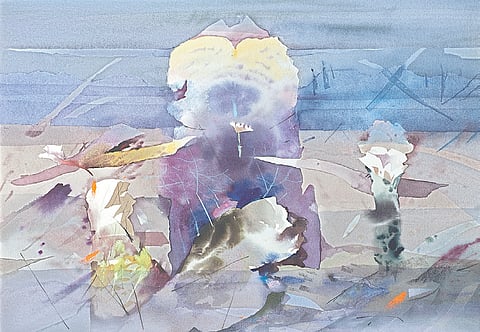


Fondly known as Bimal da, Bimal Dasgupta was famous for his sublime landscapes. An unsung master of ethereal landscapes, he died in a car crash in 1995 at 78. One has seldom seen his works since. It is in this context that the upcoming show of abstract landscapes titled Innerscapes at Delhi’s Gallerie Ganesha holds great significance.
Dasgupta’s abstract paintings are a sublimation of his visual experience, transmitting the power that commands the seas, the sky, the wood, the green grass or the stark ridges. In each of his works, there is a juxtaposition of the horizontal and the vertical which showcases a consummate artistry over his medium of watercolour. Irrespective of its external identity, the image grows into a harmonious whole. The artist’s dexterity converts mass into transparency, prosaic idols into poetry. The most remarkable aspect of his art is that it reflects the true Indian ethos, one strong enough to assimilate tradition and modernity.
Dasgupta felt that the decorative elements of his works or his material success were incidental. Standing before a dreamy mountain scene, one does not look either for the mountain or the monetary value of the piece. Each painting is like an encounter with an inner reality where there is no action, no pontificating. The only criterion is the ultimate truth. Earlier in his career as an artist, Dasgupta worked with oils.
He is quoted to have said, “I believe if an artist has mastered one medium, he can work in the others as well. I paint only when I am in the mood. The colours are always there in my heart and an unseen power in the background drives me to put them down on canvas.”
His student years were spent with an uncle in Behrampur and he joined the Government Art School, Calcutta in 1937 as a student but could not complete the six year course due to financial restrictions. It’s said that his parents discouraged him from becoming an artist and since there was no money to buy colours and canvases, he did several part time jobs to fund his art education. He painted landscapes that gave free rein to his penchant for nature and its fanciful shapes and colours, with the ocean being an endless source of fascination. Several of his paintings are surrealistic and abstract in his depiction of the teeming life underwater.
He moved to Delhi and started to work as a commercial artist. Later he taught at the Delhi Art College and pursued painting on his own. He was primarily interested in watercolours, but painted in other mediums as well. He had to give up oils when he developed an allergy to turpentine and linseed oil. Thereafter, he took up acrylic. But his preferred medium always remained watercolour.
Moving slowly but surely from realistic images to completely abstract ones, Dasgupta used textural changes and sharp, defined colour schemes, making his landscapes come alive with shifting shapes and barely visible forms. The Lalit Kala Akademi conferred a national award on him in 1956 and a fellowship in 1989. In 1961, he was given a government scholarship for a six month stay in Europe.
(Poonam Goel is a freelance journalist who contributes articles on visual arts for unboxedwriters.com)