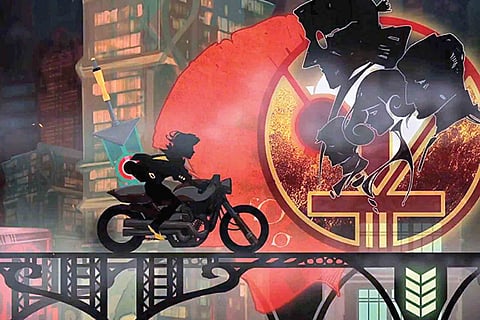

CHENNAI: You play as Red, a singer who can no longer talk due to an attack on her life by the Camerata. She gets a sword called the transistor, which can absorb people’s energies, enabling it to help Red out. Your story is one of revenge. The Camerata have created robots that are called the process, so you have to battle the process to reach your ultimate goal. Now this game is an RPG, so a levelling system is involved.
As you progress, you get functions, which act as your skills. Red is given a fixed amount of memory, which limits the number of functions you can have running simultaneously. And as you level up, you get to choose between two functions, slot upgrades (function upgrade or passive slot unlock, or memory increase), and you are presented with limiters, which make enemies stronger based on the limiter you use.
But defeating enemies with limiters on gives you bonus experience, which means you level up faster and are therefore stronger. Each skill slot has two passive skill slots that can be unlocked as you level up, which then means you can insert some functions to work in conjunction with the main skill you have chosen, and everything mixes and matches, giving you some unique effects.
But do keep an eye on the memory meter. The graphics of this game are beautiful, the narrative is shown through a noir-esque art style which I feel is fresh, and rather cool. The art style itself is very well done.
Game play: while entering combat, you can go into what the game calls turn() mode, which is a planning mode. Here you have a bar at the top of the screen, and depending on whether you move or use an attack, that will fill up.
Once it’s full, you can’t perform any more actions. Once you have confirmed what you’re going to do, run the turn and Red will perform all the things you planned. Backstabs are the best way to beat enemies, so whenever possible, get behind your target and unleash some critical damage.
While the enemy variety is not amazing, there are several tiers of the same enemy with different functions; some enemies teleport as soon as you hit them, which can make your plan a complete waste of resources, like the robots named Young Lady. As enemies level up, they hurt more, have more health, do more damage and are smarter, so you have to think on your feet and use your turn() smartly.
The sound track is, for lack of a better word, epic. What the composer calls old-world electronic post rock, conveys an atmosphere that’s ever changing and the music itself is beautiful.
Now for the issues. The story line can be quite confusing, considering that you learn what happened in the game earlier only as you play and by accessing consoles around the world.
So if you miss something, it may be an important part of the lore, such as the reason you were attacked, the identity of the Camerata, and their plans. You can play most of the game with your starting functions and augmenting them with other functions.
The end game functions need a lot of memory but don’t give much in terms of damage control or strategic play. The lack of different types of enemies can make combat seem repetitive, as almost every battle has the same enemies in different combos, with upgrades from jammers to shields to stealth.
The game is good. It’s really good—short, but fun. Boss fights are super fun, and while I wish there was more in the game itself, I had an absolute blast while playing.
The music and art style are what drew me to it in the first place, and the game play sealed the deal. You can buy and download the game on Steam for $20, and it’s worth every penny. I give it a solid rating of 9/10.