

I spent ten days in the hill station of Dalhousie in Himachal Pradesh. Dalhousie holds a special place in my heart; it is where my love for nature took root. During my younger days I’d spend two summer months at my grandparents’ home in Dalhousie. I’d go on long walks, exploring pagdandis (narrow jungle tracks) and just taking in the serenity and calmess of nature.
Nowadays my visits to Dalhousie are infrequent. When I do visit, the pleasant memories come flooding back. This time my wife, Anchal, accompanied me to Dalhousie. Our long walks were punctuated with stories of my adventures and experiences in the hill station. On some of the trails that I had not visited for a while, Anchal was uncertain whether I would be able to find my way around. But I told her that though I lose my way in the urban jungles that our cities are (I often get lost in Dehradun where we have lived for six years now!), take me to a forest and I will unerringly find my way around. Thankfully, I was able to come out with my reputation untarnished!
The summer months of May and June are lovely in Dalhousie. The clear blue skies with the few scattered clouds, an occasional afternoon shower and the clean fresh air of the Himalayas are invigorating. A milieu of bird calls accompanied our walks and colourful butterflies flitted about.
In this season, another attraction is the fruit bearing bushes and plants. The yellow Himalayan raspberry (Rubus ellipticus) and the hill raspberry (Rubus niveus) had just begun to bear fruit. How we gorged on them during our walks!
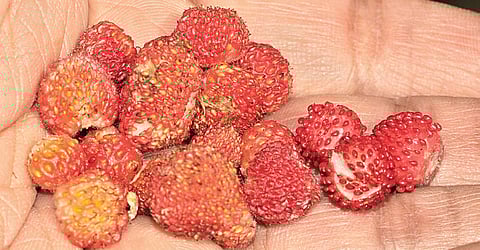
However, pride of place among the wild fruit went to the wild strawberries (Fragaria vesca). On the sunny hill slopes, the forest floor was dotted with the small but delicious strawberries. Anchal gobbled up so many of them that my father told her jokingly that the Dalhousie Municipal Corporation would probably tax her for doing so! Earlier, the summer day ritual would be to go to the hill slopes with my cousins with small wicker baskets and collect the wild strawberries. Collecting wild strawberries is an art. Accompanying the edible and tasty wild strawberries are the mock strawberries (Duchesnia indica), which are not at all tasty. The mock strawberries look similar to the wild ones but have larger, well-spaced protrusions on the fruit (see the three berries on the right of the photograph). Other than eating delicious strawberries and cream, my grandmother would make us sumptuous strawberry jam. Sounds yummy, doesn’t it?
For reasons unknown to me, the wild strawberries in Dalhousie have been decreasing. There is no longer a carpet of red strawberries on the hill slopes. It could be due to increased cattle grazing, increased human construction or the impact of global warming. Like in every other part of the country, nature is changing here too. Whether the change is for the better or for the worse, only time will tell.
Feedback and queries are welcome at sanjay.sondhi1@gmail.com