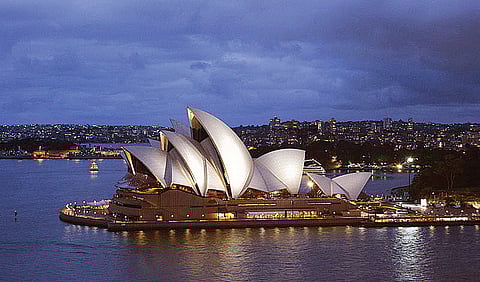

“The sun did not know how beautiful its light was, until it was reflected off this building,” said American architect Louis Kahn when he saw a cluster of pearl white soaring sail-like shells, reflecting and reaching out for the sky over the Sydney Harbour. This is the Sydney Opera House.

An awe-inspiring urban sculpture set in a dramatic waterscape, at the tip of a peninsula projecting into Sydney Harbour, Sydney Opera House stands out as a masterpiece of 20th century architecture for its unique design and construction, and unparalleled engineering and technological innovation. Sydney Opera House endorses the classical design principles while standing high as a modern expressionist form. Respect for site, response to light, sensitivity to materials and textures, and harmony of space, scale and proportions is the design foundation on which architect Jorn Utzon crafted the unique form of the Sydney Opera House.
In January 1957, the young Danish architect won an international design competition held by the government of New South Wales for an opera and concert hall complex to be built on a site projecting into the Sydney Harbour. The criteria specified a large hall seating 3,000 and a small hall for 1,200 people, each to be designed for different purposes, including full-scale operas, orchestral and choral concerts, mass meetings, ballet performances and other presentations. According to legend the Utzon design was rescued from a final cut of 30 ‘rejects’ by the famous Finnish American architect Eero Saarinen, who received 233 entries from architects of 32 countries!
The construction started in 1957 and was completed in three stages. Roof structure of such a scale and complexity cannot be built without a defined geometry and mathematics. Engineers Ronald Jenkins, Jack Zunz and Peter Rice of Ove Arup and Partners worked hard for three years and made this roof possible, with the help of a special 3D computer program written by Rice.
The roof consists of a series of large precast concrete panels shaped as ‘shells’ and supported by precast concrete ribs on a monumental podium. A closer view of the lustrous white shells reveals a very elegant tile system of a subtle chevron pattern composed of more than one million fifty thousand glossy white and matte cream tiles. The scale of the shells was chosen to reflect the internal height requirements, with low entrance spaces, rising over the seating areas up to the high stage towers. The building covers 1.8 hectares of land and is supported on 588 concrete piers sunk as much as 25 m below sea level. The podium is surrounded by large open public spaces and a forecourt with monumental steps which is regularly used as an outdoor performance space. The building also houses a recording studio, cafes, restaurants, bars and retail outlets.
Under the spectacular roof form, Utzon designed grand volumes and large windows. However, he was unable to complete this part of the design as he was forced to resign when a new Liberal government was elected.
The Opera House was formally completed in 1973 at a cost $102 million, and opened to the public by Elizabeth II, Queen of Australia, on 20 October 1973. Today it is among the busiest performing arts centres in the world, hosting over 1,500 performances, attended by more than 1.2 million people, every year. Utzon was honoured with the Prtizer Prize in 2003, and the Sydney Opera House became a Unesco World Heritage Site on 28 June 2007 endorsing, ‘It stands by itself as one of the indisputable masterpieces of human creativity, not only in the 20th century but in the history of humankind’.
(The author, an architect and educator, can be reached at Vani.Bahl@gmail.com)