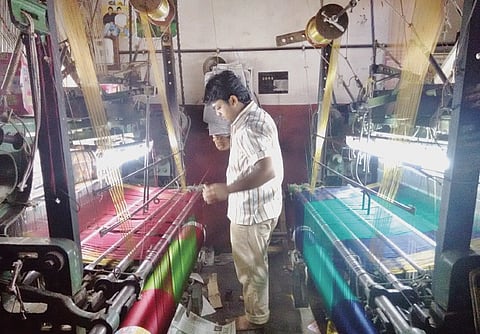

CUBBONPET: Once a bustling centre of weaving in the heart of Bengaluru, Cubbonpet is now bereft of almost all its looms.
Traditional weaver families have shifted to place likes Yelahanka, Kamakshipalya, Sriramapuram, and Kamalanagar.
“I moved from Cubbonpet to Kamakshipalya 20 years ago, as I faced labour problems and the business collapsed suddenly. Rents are high in Cubbonpet, and many weavers shifted out during that period,” said K Srinivas, who now runs power looms in Kamakshipalya.
Dr R Rajaram, Associate Professor, St Joseph’s Commerce College, says the Devanga community, which traditionally practised weaving in Cubbonpet, has moved out.
“Now Jains from Rajasthan and goldsmiths from Bengal have arrived and taken over the buildings that housed looms in Cubbonpet,” he told City Express.
Almost all looms that once produced silk saris have shut down in Cubbonpet. A good number of weavers have moved out of their ancestral trade and switched to driving cabs and autos, people in the area say. Women loom workers have joined garment factories. Some weavers work for daily wages at the city’s construction sites.
Weaving, dyeing and rolling yarn doesn’t fetch even subsistence wages any more, workers say.
Nithin S R, now a powerloom worker, told City Express, “The pay hasn’t gone up over the years. My father used to earn `200 a day, and I earn the same amount.”
With the boom in call centres and BPO firms, many weavers look at driving cabs as the route to a less difficult life. Some building owners in Cubbonpet have sold their looms and rented out their buildings to paying-guest hostels, catering to those who need to be close to Majestic for work.
Owners and weavers say power looms call for frequent repairs and help is not easily available. And power cuts are another worry: most in the business cannot afford generators.
With the advent of art silk, raw silk and China silk, pure silk is losing its sheen in Bengaluru.
“Those varieties are cheaper when compared to pure silk, for which the city was known. Being a silk weaver was a matter of pride, but now the condition is so bad nobody wants to marry a weaver,” said Harsha, a silk weaver now working from Kamakshipalya.
The urban expectation of a noise-free neighbourhood is also a reason for the shifting of looms to the outskirts of the city.
“In many cases, neighbours complain about the noise caused by looms,” said Padma, who now owns powerlooms at Kamalanagar.
Weavers battle recurring debts, even as Cubbonpet, reverberating with the sound of the loom just two decades ago, is a congested old city enclave like any other.