
BENGALURU:
1Common name of the bird: The Red-whiskered Bulbul.
2Scientific name : Pycnonotus jocosus
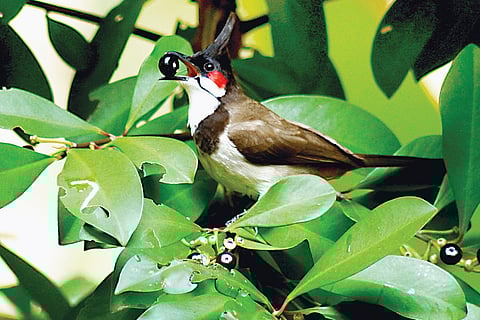
3Distinguishing/identifying features: The Red-whiskered Bulbul is a bird that is slightly plumpier and bigger than a House Sparrow. It has a brownish colouration on its back and white near the throat, breast and belly. It has a red vent. It has an almost incomplete black “brest-band”. Its head is beautifully coloured with black, white and red. It has a prominent, erect and slightly forward pointing crest -- which is its identifying feature. A small, but conspicuous bright red patch just below its eye was just enough for it to be named as the Red-whiskered Bulbul.
4Some Interesting facts about the bird: The Red-whiskered Bulbul is a resident bird and is commonly found in most of our gardens, small wooded areas and parks in the cities. Sometimes they can also be found in forests. It feeds on a variety of small fruits – ranging from the black ripened fruits of the Curry Leaf trees to small berries of the Lantana plants -- and even on insects which they mostly fetch from trees. They usually go up the tree or on to a prominent perch on a tree and utter a loud, tinnier call : “kudi-kudi-kudi-Kyuu” -- which they repeat at periodic intervals.
Bulbuls help in dissemination of seeds, thus help in increasing tree cover. They are particularly fond of the black globular berries of sandalwood tree and help in dispersal of its seeds to places far and wide.
From November to May they are extremely territorial, and during their breeding season – they even chase other bigger birds who venture close to their nests. Their nest looks like a small bowl – made up of leaves, grass and small twigs – that is built concealed within the bushes. The female lays two to three eggs. After the eggs hatch in about 15 days, both the parents share their duties of feeding the chicks.
5Threats and disturbances the bird faces: They love being in areas filled trees that provide them berries and insects. As in the case of many smaller bird species, these bulbuls too have become just mute spectators of their habitat loss. The garden space which once sprawled everywhere in the cities is now becoming lesser, thinner and noisier – thus leading to reduction in its numbers. The decrease in the number of these Red-whiskered Bulbuls is resulting in reduction of tree cover -- especially the sandal wood trees.
(The writer is a member of Birdwatchers Field Club of Bangalore)