
BENGALURU:
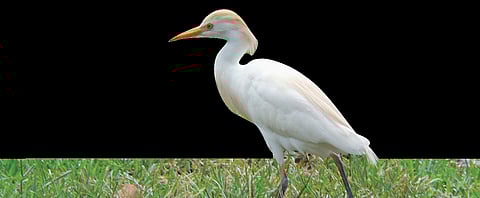
Common name of the bird : The Cattle Egret.
Scientific name: Bubulcus ibis.
Distinguishing / identifying features
The very word “Egret” has been derived from an old French word “Aigrette” which refers to the long plume that is worn on hats or as an head-dress (especially by the high-society ladies in the olden days, and it would be especially be the one of those long egret feathers). The cattle egret is almost the size of a house crow, with longer legs and neck. Both the male and the female birds are similar looking – bright white in colour with sharp, straight, pointed, yellow coloured beak. They have a long neck and greyish yellow legs. During breeding season these birds develop a beautiful golden yellow-coloured feathers on their back, breast and on their head – but otherwise, during the non-breeding season, these birds are fully white.

Interesting facts about the bird
The cattle egret is a resident bird and is found quite commonly in most of our wetlands like city and village tanks, ponds, water-logged grasslands, farmlands and in the paddy fields. But unlike other different species among the egrets, the cattle egrets venture out more into the drier and open fallow lands in search of insects. They invariably follow the grazing domestic cattle and even other wild animals in the forests as they move along, because when the cattle graze, they disturb a lot of hidden insects and other smaller vertebrate preys. These cattle egrets quickly pick these insects and eat them up. They even clean up the paddy fields and agricultural lands by feeding on a wide variety of harmful insects which would otherwise damage the healthy crops.
This very act of going behind the cattle in search of insects has earned their common name as the “cattle egret”.
Sometimes, they do what seems to be like ‘jolly riding’. But here, they actually get on to the backs of the cattle and other wild mammals only to pick ticks and fleas on and eat them up.
The cattle egrets are generally found in small flocks of about 10 to 15 birds but sometimes we get to see a larger flock of over 30 birds on a larger wetland. They are generally silent birds. They make a harsh-sounding “kreeaak....kreeaak.....kreek” calls when they are disturbed. These cattle egrets generally feed on insects like grasshoppers, moths, crickets, ticks, maggots, flies, earthworms, small crustaceans and even frogs.
They start breeding just before the onset of the monsoon – end of May. Their nest is a crude platform made up of sticks and twigs built at about 20 to 25 feet height on the trees. The female lays about four white, oval shaped eggs. Both the sexes share the task of incubating the eggs.
(The writer is a member of Birdwatchers Field Club of Bangalore)