
BENGALURU:
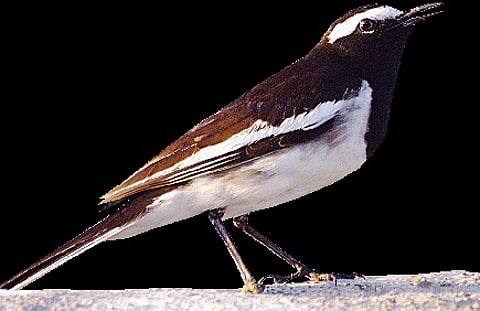
Name of the bird: The Large-pied Wagtail
Species/ sub species: It is called by its scientific name Motacilla Maderaspatensis.

Distinguishing/identifying features : The Large-pied Wagtail, also called the White-browed Wagtail, is slightly bigger than the House Sparrow and is the largest member of the Wagtail family. As its name suggests, it keeps wagging its tail restlessly. The word Pied in its name denotes that it predominantly has the black and white colouration. It has black on the top and white below, and has a prominent white “eye-brow”, a white shoulder stripe and outer tail feathers.
The male birds have a rich black colour and the females a dull greyish-black colour.
Interesting facts: It is a resident bird and is common in small water bodies. It has adapted to urban environments and is often found perched on overhead water storage tanks in residential buildings. This species is usually seen in pairs or small groups near open water. They call often, especially in the mornings, and are very active.
The song is long and loud with many different notes. The usual call goes “wheech-wheeich-which-which-which” repeated very often. They can fly for long distances and form a characteristic garland-like flight pattern with dips and rises.
The breeding season for these birds is between March and October. During courtship, the male flies up into the air, sings and glides with puffed out feathers. On settling down, the tail of the male is raised high and wings held up over the back as he steps near the female. The female responds by crouching and shaking the wings.
They build a cup-shaped nest which is placed on the ground or on the rocks in a hole always located close to water. It also has other material with an inner lining of hair and small feathers. They usually lay three or four eggs.
Threats it faces: It was once commonly found on top of most of over-head storage tanks of buildings in Bengaluru.
It has now become quite a rarity, probably due to declining availability of small insects, caterpillars and spiders with which it feeds its young ones and also from lack of proper nesting spots like crevices on roof tops.
Also, plastic water tanks have now replaced the older model of cement or brick-walled ones.
(The writer is a member of Birdwatchers Field Club of Bengaluru)