
BENGALURU:
1. Common name of the bird :The Common Myna.
2. Scientific name : Acridotheres tristis.
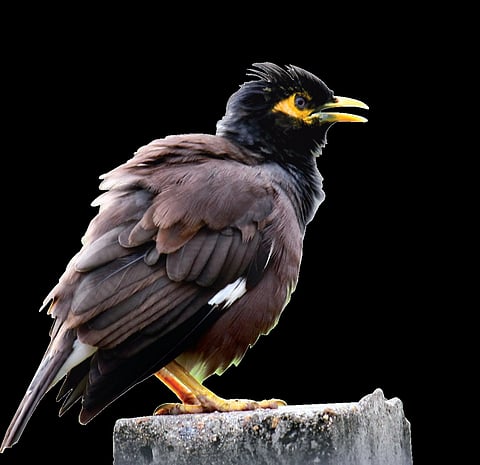
3. Distinguishing / identifying features : The Common Myna is, as the name suggests, commonly found in our cities and villages. It is about half the size of a House Crow. It has a rich brown body with blackish head, tail. The tail tips are white. There is a white patch on either side of the wings and they stand out as big white blobs, at the centre of the wings, when the bird flies. Their beak and legs are yellow, and have a yellow marking behind the eyes. Both the male and female birds look alike. The Common Mynas are easier to spot than their close cousins - the Jungle Myna.
4. Some Interesting facts about the bird: This is a resident bird and most of you might have seen it in lawns, gardens, parks and sprinkled across residential layouts in our cities and also in the cultivated lands in villages, throughout India. It generic name “Acridotheres”, in Latin, literally means “grasshopper hunter”. Needless to say, it is particularly fond of grasshoppers, locusts and crickets and hence, these mynas are usually found in open grasslands foraging. Apart from grasshoppers, these Mynas also feed on other small insects, fruits, seeds, small reptiles and even food discarded by humans - such a wide range of diet makes our Common Myna an omnivore - which means, it readily feasts on both animal / insect and plant-based foods. These birds hop and also walk searching the ground for insects.
When disturbed, they flit away to higher perches. These birds are generally found singly or in pairs or sometimes we even get to see them in flocks of about 10 to 15 birds.
They are quite noisy, especially when in a flock. Their are chattier when they assemble in the evening hours at a common roosting place. The Common Mynas are known to make a wide variety of calls, from croaks and squeaks to whistling and chirping. They keep bobbing their heads as they walk among the grasses and calls out a quick “tweeek” as they suddenly take off. Common Mynas are even kept as pets in cages because of their ability to produce a wide varieties of calls. Our myths refer to them as “Kalahapriya”, meaning ‘One who is fond of getting into arguments’! It is indicative of the nature of its calls.
The Common Mynas are known to breed almost throughout the year. Their nest is a hole in a tree usually made by the barbets or woodpeckers. Sometimes even a small natural crevice in a tree is also sufficient for it to nest. They readily take to the nest boxes laid out by us and make it their nest. Even small holes in the wall of any old houses and buildings are enough for the Common Myna to build its nest. Once it chooses a hole as its nest, both the male and female birds engage in filling it up with twigs, straws, dry grass, fibres, human hairs and small feathers of other birds to make a nest inside the hole. The female lays four to five light-blue coloured eggs and incubates them for about 20 days before the young mynas are hatched.
The writer is a member of the Birdwatchers Field Club of Bangalore.