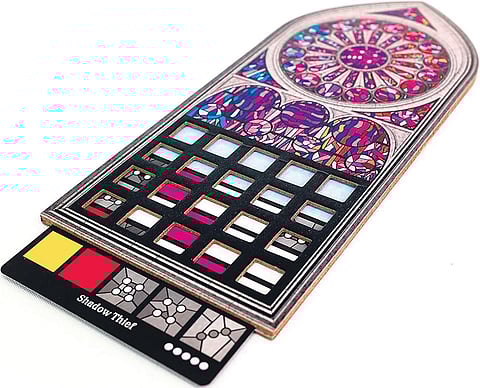

BENGALURU: Most board games are a combination of three things gameplay, presentation and theme. Most gamers will forgive a game for easing up a bit on the latter two areas as long as the gameplay is solid; but it’s the mark of a good game when all three have a distinct quality. However, you know a game is exceptional when each of these three facets blends together into a single cohesive whole, which is the case with Sagrada.
In Sagrada, players are artisans who have come together to work on the stained-glass windows of the Sagrada Familia one of the largest and most famous churches in the world. Each of you is working on your own portion of the design, and only one of your creations will be judged the most beautiful (that is, which scores the most points) at the end of the game.
Over the course of ten rounds, players will take turns drafting dice one at a time from a central pool. You’ll take two dice every round and slot them into your personal window-shaped player board and this is where Sagrada starts to shine. You see, the dice you’re drafting are translucent, and they look absolutely lovely when you slot them into the 3D grid that’s part of your window which holds them firmly in place. That’s top marks all around for theme and presentation already; but what about the gameplay?
For such a pleasant-looking game, it doesn’t take long before Sagrada starts showing its teeth. Drafting from a common pool is already an exercise in determining what you want as well as the likelihood of it still being there when it comes back to you, but then the game adds restrictions to your player board. Certain spots require particular dice to be placed on them that corner space might require a red die, for example, while the one right next to it must be a 4.
That’s tricky in itself, but then you arrive at the core puzzle of Sagrada which is the restriction that you cannot place dice into your grid if they match either the colour or the number of any adjacent dice. And suddenly, matters become much more frenetic. That yellow 6 is perfect for you; but, if you take it, you could find yourself unable to take any of the remaining dice when it comes back round again. It’s deliciously agonizing, and only gets more so as the game goes on.
I haven’t even mentioned the objectives both public and private that are randomised every game, nor the special tools (again, randomly selected) that allow players to break the rules in particular ways. The quicker you use a tool, the less it costs; but the longer you wait, the more pieces of the puzzle you’ll have in your hands so as to better maximise your design. That, like everything else about Sagrada, is a conundrum that you will love puzzling your way through.
What’s New?
Nanga Parbat
My copy of Nanga Parbat arrived a few weeks ago, and it’s just as engaging as I’d hoped. This is a clever little two-player game, which takes the mechanics found in ultimate noughts-and-crosses and translates it into a wonderfully sharp head-to-head duel.
It’s a Wonderful Kingdom
Speaking of sequels, It’s a Wonderful Kingdom is doing pretty well for itself on Kickstarter as well. This is the two-player-only reimplementation of the excellent It’s a Wonderful World, and looks to be reinventing the formula in a few key and interesting ways.
Marvel United: X-Men
Marvel United was one of the biggest Kickstarter hits of 2020, and it’s back on Kickstarter right now with an X-Men-themed sequel. There was a ridiculous amount of content on offer with the first campaign, and this one looks to be following suit.
Arjun Sukumaran
http://goo.gl/uNBWN3
(Arjun is a gamer, book lover and an all-round renaissance man)