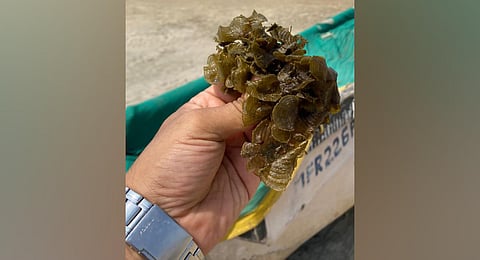

BENGALURU: There is treasure hidden in our oceans, or at least, that’s what the fairy tales say. This treasure comes in many forms, and not necessarily only as gold and gems. Deep within the vast bodies of water, rests a treasure so invaluable, it possesses the ability to conserve trees on land.
Nowadays, recycling paper using sustainable methods, while protecting thousands of trees, is in vogue. However, despite the abundance of such eco-friendly solutions, they often pinch the pocket. This irony of sorts bothered 39-year-old Roshan Ray, who discovered an innovative way to produce handmade paper using seaweed and garment waste, through his noble venture – Seed Paper company.
The Seed Paper Company makes sustainable paper products, including plantable seed paper, plantable seed pencils, seed paper calendars, and personalised eco-friendly hampers. Ray’s approach utilises a combination of 50% seaweed and 50% garment waste to create unique paper. Not only does this provide an eco-friendly alternative to traditional paper production methods, but also helps achieve a richer paper quality. While the garment waste is sourced from Tiruppur in Tamil Nadu, the seaweed c o m e s f ro m Gokarna.
The environmental enthusiast was vacationing in Goa when he had his eureka moment. He saw seaweed scattered across the beach. Not knowing what to do with it, he collected 2 kg of seaweed and brought it to Bengaluru. He cleaned the seaweed and boiled it together with some garment waste, which softened the resulting material. Ray then blended the mix and was surprised to see the strong texture that the combination produced.
With 2 kg of seaweed and 1 kg of waste cloth, Ray was able to make 30 sheets of handmade seaweed paper. “The best part about this paper is that it feels like you are carrying a part of the ocean with you,” Ray tells TNSE, adding that with no chemicals or perfume being added to the paper during production, it naturally smells like seaweed and takes one back to the beach.

Explaining his choice of using seaweed as a primary material, he says, “It’s renewable. As long as we have oceans, we will never run out of seaweed. We are only looking at land to find sustainable alternatives, nobody is taking a peek into the oceans.”
Advantage seaweed Elaborating on ‘seaweed as a raw material’, Ray mentions that it grows faster, which allows large quantities of paper production while helping mitigate the threats of deforestation and climate change.
According to various studies, it takes 17-24 trees to make one tonne of standard office paper. Paper consumption in India is likely to witness 6-7 per cent annual growth, touching 30 million tonnes by FY2026-27. As per the Indian Paper Manufacturers Association (IPMA), the country’s paper usage will increase because of emphasis on education, literacy and growth in organised retail.
Meanwhile, experts say the sustainable paper market can be quite profitable for India, given the country’s long coastline. India can scale the business and give jobs to people living near the sea. Also, converting seaweed into paper can help promote a circular economy.
“Right now, all sustainable products are made only for the rich. The middle-class or the poor cannot go for an eco-friendly option, as they can’t afford it,” says Ray, stressing the need for products to be priced aptly for the masses that will “really bring about a change”.