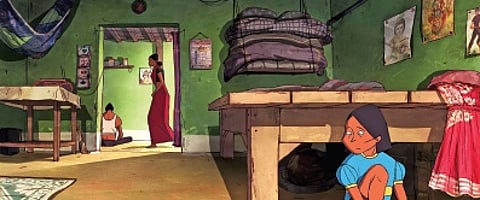

BENGALURU: Some stories need a voice to be told and a medium to showcase. Many stories from rural India get lost in history before they even get a chance to be narrated. Govinda Sao’s Maatitel, an eight-minute animated short film, tells a story that many might be aware of but rarely speak about.
The film, scheduled to be screened at the upcoming Seoul Indie-AniFest 2024, won the Lotte Reiniger Award at the Annecy International Animation Film Festival earlier this year. Sao is quite pleased with the international reception of his film. “They were shocked, and there was silence after watching the film. The feedback has been mostly positive,” he shares, adding that it took him around 1.5 years to make the film.
Maatitel means kerosene – a vital liquid fuel used in rural domestic India – in Chhattisgarhi. The story centres on a family of four – a husband, wife, and their two children. It’s set against the backdrop of domestic violence in rural Chhattisgarh, offering a slice of the family’s life. “We are just exploring a moment of their life. They could have the most mundane life, which can be easily missed, but it’s a different world in itself. It’s a chance for the audience to know what happens in their lives, which is otherwise unknown,” explains Sao, who was recently in the city.

Writing a complete story might be easy, but picking a single situation can be challenging, says Sao. “There wasn’t any single source of inspiration for the film. It was a series of experiences and observations. I have grown up in that environment, the rural setting. It is somewhat inspired by the series of experiences and situations that I came across from my childhood. You would see those moments of very intense arguments and fights between the husband and wife, which ultimately intensify to an unbearable extent,” says Sao, who also hails from Chhattisgarh.
Sao recalls being exposed to incidents like self-immolation, suicides, and murders within these families and societies. “When I was home during COVID, I heard many such incidents, and it kind of pushed me to tell these stories,” says Sao.