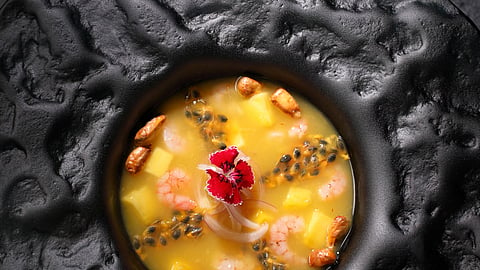

In recent months, the city’s culinary landscape has expanded to welcome a wave of Peruvian and Latin American concepts that bring not only novel ingredients and techniques but also a deeper cultural narrative. Peruvian cuisine is a rich tapestry shaped by biodiversity and history. From the Pacific coastline and the Andes to the Amazon rainforest, Peru offers an unmatched variety of native produce. It is home to thousands of varieties of potatoes, rare chillies, tropical fruits, ancient grains and wild meats. These ingredients form the backbone of a cuisine that is earthy and refined, traditional yet constantly evolving.
What makes Peruvian food truly global is its history of migration. Over centuries, Peru welcomed waves of settlers – Spanish, African, Chinese and Japanese, who introduced their own culinary traditions. Among these, the Japanese-Peruvian fusion known as Nikkei cuisine has gained significant international attention. Nikkei combines Japanese techniques and precision with Peru’s dynamic ingredients, resulting in dishes that are clean, citrusy and visually elegant. The familiar yet distinct flavours of ceviche, tiradito, anticuchos [grilled skewers] and ají rocoto [spicy red pepper] have begun to charm Indian palates.
RIKO, a Peruvian-Latin standalone restaurant recently opened in UB City, conceived by the Kofteci Group, known for restaurants like Oz by Kebapci and Klava. RIKO is both an homage and reinterpretation, its name means ‘delicious’ in Spanish, a promise delivered across seven sections of a thoughtfully curated menu. Highlights include bomba de choclo, a crispy corn custard sphere, and ceviche de mango y maracuyá, where passion fruit and lime elevate fresh prawns. The robust pollo a la brasa, a rotisserie chicken cooked over an open flame, pays tribute to traditional fire-led cooking, while desserts like cachapa con miel, a corn pancake drizzled with honey, offer comforting finishes.
RIKO’s approach is unconventional in more ways than one. It does not serve alcohol, focusing instead on innovative, flavour-driven non-alcoholic beverages. Think Brazilian lemonade made with lime and condensed milk, and a cooling cucumber-coconut agua du fresco. Its interiors, too, reflect a blend of old and new, with clay installations, microcement textures and a curated library of cultural artefacts. “RIKO is about memory, not mimicry,” say co-founders Aasim and Adeeb Shah. “Our aim was to interpret Latin American culinary traditions with integrity and intent.”
Adding to the Latin wave is the newly opened Una Hacienda, perched above Bengaluru’s busy streets with a beautiful conservatory. Designed by bar maestro Arijit Bose for the hospitality firm Investorant, this space evokes the spirit of a traditional Latin American estate house. Bose describes the concept as a return to the informal intimacy of evenings spent at a friend’s home, long before Bengaluru’s nightlife exploded. With tropical foliage, vintage furniture and golden lighting, Una Hacienda exudes a laid-back charm that is both nostalgic and modern.

Its rooftop bar, Barra Arriba [‘bar on top’ in Spanish], offers breezy views and a refreshing cocktail list that leans towards Palomas and Pisco Sours. The food, curated by Chef Jason of 42 Consulting, roams across Latin America. From Nikkei-style tiraditos and ceviches to Pozole [a rich Mexican broth] and the classic Cubano sandwich, the menu is wide-ranging yet carefully assembled. More than just themed décor with themed dishes, Una Hacienda is a genuine tribute to the soulful cultures of Mexico, South America and Puerto Rico.
Luxury meets Latin flair at The Oberoi, Bengaluru, where their fine-dining restaurant Wabi Sabi recently presented diners with a limited-time Nikkei menu. The idea was to get feedback from diners on these limited dishes and then incorporate them into the main menu going forward. Led by Randy Cultivo, the offering is inspired by his culinary travels through Peru. The new dishes on the menu reflect the essential harmony of Nikkei, where Japanese restraint meets Peruvian exuberance. Signature dishes include tiradito, tenderloin and bone, and ceviche de atún spiced with fresh jalapeños.
Wabi Sabi’s Nikkei menu seamlessly incorporates local ingredients too, like banana stem and jamun granita, alongside imported Hokkaido scallops and Cochin bay prawns. Even the desserts, such as chimu-reimagined, caviar box, and flavours of yutori, celebrate the spirit of creative fusion. The ambience is elevated by a serene lily pond and waterfall, accented with kintsugi-style ceramics and gold leaf. “Nikkei cuisine allows me to celebrate precision with play,” says Chef Randy. “It’s a genre that harmonises Peru’s exuberance with Japanese restraint, perfect for the modern diner.” Diners can look forward to tasting these dishes now on their main menu.