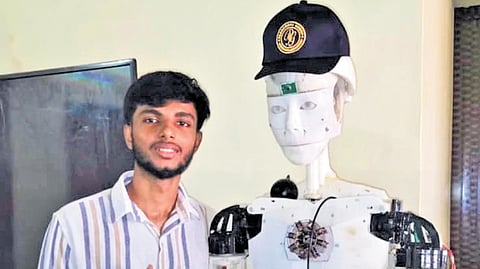

MANGALURU: Sushanth Sujeer Kumar, a 22-year-old graduate from Srinivas Institute of Technology, Mangaluru, has developed ‘Friday’, which according to him, is India’s first self-learning humanoid robot. The project, inspired by Marvel’s Iron Man, is now undergoing tests for the “first in India” tag.
A resident of Uppala in Kerala, Sushanth completed his degree in Robotics, Artificial Intelligence, and Machine Learning this year. His passion for robotics began in childhood, sparked by fictional hero Tony Stark.
“Watching Iron Man’s advanced suits made me imagine what it would be like to bring such machines to real life. I also got fascinated by Elon Musk and Marc Raibert, that’s where my journey started,” he said.
Sushanth began dismantling toys to build drones and planes before creating advanced robots. His key projects include ‘Friday’, an InMoov based humanoid powered with Large Language Models (LLMs) to interact and learn continuously; ‘Lumia’, a robot using SLAM (Simultaneous Localisation and Mapping) technology that combines autonomous navigation with emotional communication; and ‘Genie’, an educational robot being developed to help students learn robotics. He believes they are India’s firsts with their own features.
“Friday will always be close to my heart because it was my breakthrough,” Sushanth said, adding that building the humanoid took nearly three years of designing, 3D printing, assembly, and programming.The young innovator relies on 3D-printed parts, sensors, motors, and advanced boards such as Raspberry Pi and Jetson Nano, with Robot Operating System as the software backbone. He is now exploring how Large Language Models can be embedded locally in robots to enable independent learning and decision-making without relying on cloud servers.

Sushanth said much of his expertise came through formal education and self-learning. “For coding, I started with ROS through online courses and a lot of trial and error. Back then, ChatGPT wasn’t available. So I had to figure things out the hard way. Later, with ChatGPT, it became easier to clarify doubts and accelerate my learning,” he said. His foundation in electronics came while doing PCME (Physics, Chemistry, Mathematics, Electronics) PU course at St Aloysius College, Mangaluru, before deepening further during his B.Tech course at Srinivas Institute of Technology.
But his journey has not been without hurdles. “I’ve burnt boards, damaged motors, and had robots behave unpredictably due to sensor errors. Those failures taught me valuable lessons in power management, wiring, and safe coding,” he said. He has been honoured with awards for his science working models at ‘Sasthramela’ and other state-level events.
Sushanth faced many challenges in managing projects where there were limited resources and references. “When I built Friday, I used a Raspberry Pi and integrated a large language model, which made it unique. But I had to figure out many things on my own. Not to mention the extensive trial and error 3D printing cycles, constant design modifications. But all these experiences taught me to be resourceful, patient and innovative,” he said.
On how long it will take to create a robot, Sushanth said, “Simple robots might take a few weeks. But for advanced ones such as humanoid or companion robots, it takes several months. It is a long process of research, designing, 3D printing, assembling, building hardware and finally integrating them and coding. Since I often experiment with ROS and new APIs, debugging also takes a good amount of time,” he said.
“My robots are designed not just for experiments, but for education, research and exploring how machines can connect with people. Every robot I build is not just a project, but a long journey of learning,” he said.